
The bottom line
1999-2000 Budget — General government sector
Total expenses: $1,787m
Up $54.6m (3%) on the forecast outcome for 1998-99.
Total revenue: $1,723m
Up $140.9m (9%) on the forecast outcome for 1998-99 due largely to a 14% increase in grants from the Commonwealth.
Operating loss: $63.7m
Down $86.3m (58%) on the forecast outcome for 1998-99.
The 1999-2000 budget:
- lays the groundwork for a budget surplus in 2000-2001
- invests a $300m capital repayment from ACTEW towards meeting unfunded superannuation costs
- maintains funding for schools in real terms
- doubles funding for the reduction of elective surgery waiting times; and contains no major asset sales.
Moving the budget into surplus
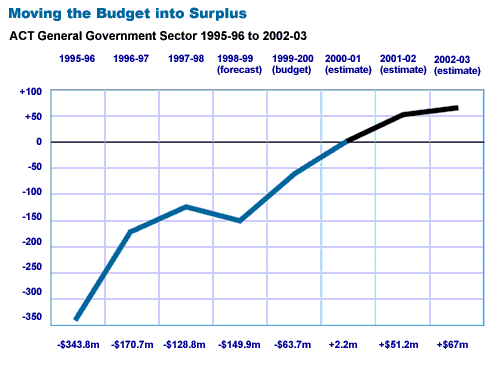
The Budget is forecast to move into surplus in 2000-2001, the first Operating Surplus recorded by any ACT Government on an accrual accounting basis. Increasing surpluses are forecast beyond 2000-2001 as shown in the chart below.
Over the past four years the ACT Government's annual Operating Loss has been reduced from $343.8m in 1995-96 to a forecast $149.9m in 1998-99.
The 1999-2000 Budget provides for a further dramatic reduction in the Operating Loss to $63.7m, a 58% improvement on 1998-99, and a result that will lay the groundwork for an Operating Surplus in 2000-2001.
Eliminating the Operating Loss is a key goal of the ACT Government and is essential to place the Territory's finances on a sustainable footing.
What is a "sustainable surplus" and why is it important?
The ACT Government aims to bring the budget to a position of "sustainable surplus" meaning an Operating Surplus sufficient to fully fund the government's capital works program without borrowing. Without a sustainable surplus, borrowings may still be required to fund capital works even if the budget is in surplus.
Superannuation and debt
The ACT has a credit rating of AAA, the highest possible, reflecting the lowest levels of debt of any state or territory and strong financial management. International ratings agency Standard and Poor's recently confirmed the AAA rating, describing the government's financial management as "impressive" in the face of significant Commonwealth cutbacks. However the Territory's unfunded superannuation liabilities represent a growing financial burden.
The 1999-2000 Budget provides for funding of $300m towards the unfunded superannuation liabilities, the largest single commitment towards meeting superannuation costs since self-government. It replaces a plan announced last year to invest $200m over four years. The $300m will come from a capital repayment by ACTEW Corporation in 1999-2000. It is a one-off payment allocated fully to superannuation provision and will not impact on the overall budget operating result.An actuarial review of the ACT's unfunded superannuation liabilities is also underway and will provide an updated assessment of the level of emerging costs and liabilities.
Improving the efficiency of service delivery
Underpinning the improved budget position is the continuous improvement in the efficiency of ACT Government operations. Over the past three years the size of the ACT Public Service has been reduced by almost 10%, or around 2,000 staff (1,300 expressed as Full Time Equivalents).
In 1999-2000 this process will continue with approximately 450 voluntary redundancies to be offered, spread across all agencies. The aim is to maintain services, but reduce the cost of delivering those services to levels that are closer to national benchmarks.
Further information: Budget paper 3, Chapter 5.1
Where the money comes from — 1999-2000 ACT government revenue
Taxes, fees and fines: $666.8m
Forecast to increase by $24.7m (4%) in 1999-2000. Payroll tax is the largest taxation item and is forecast to grow steadily, reflecting strong employment and wage growth in the private sector.
Commonwealth grants: $679.2m
Forecast to increase by $85.3m (14%). A major review of methodology by the Commonwealth Grants Commission was completed in February 1999 and resulted in a significant improvement in the ACT's share of general revenue assistance grants from the Commonwealth ($57.5m).
User charges: $137.9m
Forecast to decrease by $1.6m (1%).
Other revenue: $239.1m
Forecast to increase by $32.4m (16%). Other revenue includes land revenue from lease sales, which is expected to increase by $26.6m in 1999-2000.
Access the ACT Government revenue chart (opens image in new window)
Further information: Budget paper 3, Chapter 5.3
Taxes, fees and fines
The ACT Government aims to keep the general level of taxation in the ACT in line with surrounding New South Wales to avoid creating a disincentive for businesses and job creation in Canberra.
New measures to be introduced in 1999-2000 include:
- a new stamp duty regime, following a review of stamp duty legislation in conjunction with NSW and other jurisdictions (to raise $4.9m in 1999-2000);
- a new sliding scale of gaming machine taxation rates to provide tax relief to small clubs while increasing the tax rate for larger clubs ($1.7m);
- the issuing of licences for interactive gambling ($1m);
- a lowering from 4% to 3% of the discount applying for early payment of general rates ($425,000);
- an increase in the ambulance service levy payable by private health insurance companies, in line with NSW ($670,000);
- adjustments to Revenue Office fees and charges ($460,000);
- a Water Abstraction Charge of 10c per kilolitre to reflect the full cost of water supply and to promote conservation of a scarce resource ($1.7m);
- a "polluter pays" charge, based on similar charges in NSW, to reflect the costs that pollution imposes ($450,000 in 2000Ð01);
- renewal fee for liquor licences ($405,000); and
- adjustments to Magistrates and Supreme Court Fees, in line with NSW ($350,000).
Access the ACT Government taxes chart (opens image in new window) and ACT Government fees and fines chart (opens image in new window).
Further information: Budget paper 3, Chapter 5.3
Where the money goes
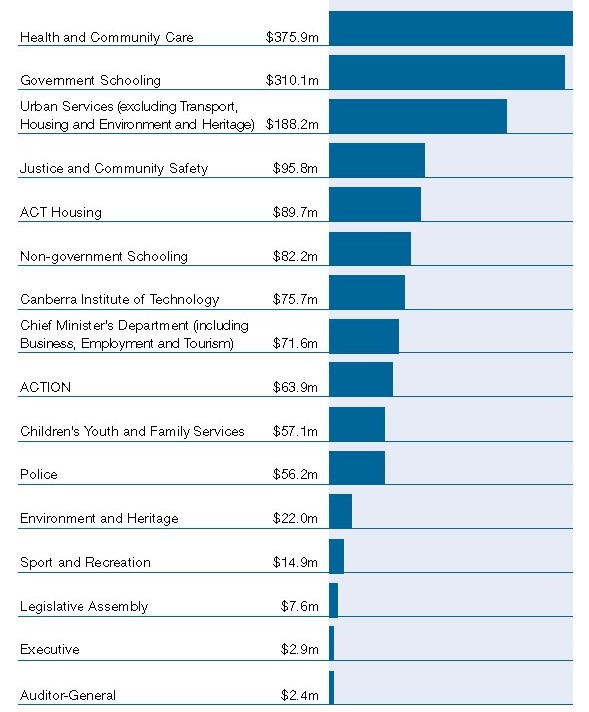
Total expenses
Capital Works
Budget funded capital works in 1999-2000 total $89.8m, comprising $60.8m for new capital works and $29m for works in progress.
The total value of new capital works in the 1999-2000 program is $87.8m. The program reflects key government priorities across areas including health, education, urban services, justice and sport and recreation.
Major new capital works projects in 1999-2000 include:
- Gungahlin roadworks, bus stops, cycleway and combined library, youth and community centre ($8.2m)
- Refurbishment of drug and alcohol service at Canberra Hospital ($1.6m)
- Upgrade of the Day Surgery Unit at Canberra Hospital ($850,000)
- Information Technology cabling across government agencies ($10m)
- Refurbishment/improvements to schools and colleges ($2.7m)
- Upgrades of science and technology areas in schools ($1.4m)
- Joint emergency services centre in Woden ($1.5m)
- Upgrading of neighbourhood precincts at Hall, Manuka, Kingston, Kippax, Weston, Dickson and Charnwood ($2.1m)
Access the ACT Government Capital Works chart (opens image in new window)
Further information: Budget paper 3, Chapter 6.4
Health and Community Care — 1999-2000 total expenses: $375.9m
Up $14.9m (4%) on the forecast outcome for 1998-99 due largely to higher levels of Commonwealth funding under the Australian Health Care Agreement, the Hepatitis C financial assistance scheme and information technology modernisation.
1999-2000 Budget highlights
Waiting list reduction ($6m)
Funding is doubled in 1999-2000 for the waiting list reduction program which aims to ensure elective surgery is provided within clinically recommended times.
Disability services ($1m)
Extra funding in recognition of the level of unmet needs of people with disabilities.
Home and community care ($1m)
Extra funding for programs that assist people with disabilities, the frail elderly and their carers.
Information technology modernisation ($5m)
Major upgrade of IT systems to ensure Year 2000 readiness, improve service provision and provide a pilot telemedicine video conferencing service in the region.
Improving patient safety ($1.5m)
Extra funding under the Quality Improvement and Safety Program which will be implemented in 1999-2000.
Hepatitis C financial assistance ($4.5m)
To assist people who received blood infected with Hepatitis C between 1985 and 1990.
Diabetes management ($300,000)
Extra funding for an Integrated Diabetes Management Service to coordinate care for diabetes sufferers.
Alcohol and drug rehabilitation for youth ($250,000)
A comprehensive residential treatment program for adolescent substance abusers will be jointly managed by the Ted Noffs Foundation and ADDInc.
Methadone program ($100,000)
Extra funding to provide up to 100 additional places on the methadone treatment program.
Correctional health services ($206,000)
Extra funding to improve nursing and other services in the Belconnen Remand Centre and Quamby Detention Centre.
Did you know...
During 1999-2000 the health budget will fund:
- treatment for more than 60,000 public hospital inpatients;
- breast cancer screening for 12,250 women;
- immunisation for 27,800 children;
- investigation and finalisation of 350 written health complaints;
- inspection of 2700 premises by public health protection staff; and
- many other community and hospital based services.
1999-2000 Capital Works
Canberra Hospital ($9.8m) including:
- Drug and Alcohol Service Refurbishment ($1.6m), involving the upgrade of Building 7 at The Canberra Hospital, housing the Alcohol and Drug Program, Methadone Clinic and residential detoxification unit. Project due for completion in December 2000 at a cost of $2.6m.
- Modifications to the Canberra Hospital day surgery facilities to improve patient comfort, expand capacity from eight beds to twelve beds and produce operational efficiencies ($850,000); and
- Ongoing refurbishment of the Pathology Building ($4.6m).
Calvary Hospital ($7.7m) including:
- Design work on Stage 2 of the major refurbishment of non-inpatient areas of the hospital, including day surgery ($500,000); and
- Completion of Stage 1 of the refurbishment, involving upgrades to the emergency and associated outpatient areas ($6.5m).
Community Care ($236,000) including:
Essential works to be undertaken at Belconnen, Tuggeranong, Narrabundah and Dickson health centres ($220,000).
Savings and revenue measures
Initiatives aimed at reducing costs or increasing revenue include:
- Canberra Hospital redundancy program ($6m)- Targeted voluntary redundancy packages will be offered where positions have become redundant as a result of improvements in work practices and other efficiencies. Savings of $11.8m are forecast in 1999-2000 under the Canberra Hospital Rectification Plan as a result of a range of efficiency measures.
- Pharmaceutical co-payment ($36,000 saving) - A co-payment for pharmaceuticals provided to outpatients and patients on discharge will be introduced from 1 July 1999, bringing the ACT into line with the states and the Northern Territory.
Access the ACT Government Health and Community Care chart (opens image in new window)
Further information: Budget paper 4
Education
Government schooling — 1999-2000 total expenses: $310.1m
Up $7.5m (2.5%) on forecast outcome for 1998-99 due largely to the maintenance of school funding in real terms.
1999-2000 Budget highlights
Funding maintained in real terms ($5.25m)
For the fifth successive year, funding for government schooling has been maintained in real terms.
Teacher renewal program ($600,000)
Aims to create 20% more opportunities for graduate teachers in ACT Government schools through a range of measures including early retirement incentives for teachers approaching retirement age.
High schools in the new millennium ($400,000)
First year of a three year program that includes a greater focus on computer competency linked to employer needs and a more flexible learning environment.
Drug education ($115,000)
To strengthen existing drug education programs from Kindergarten to Year 12.
School amalgamation incentives
Schools which decide to amalgamate in response to declining enrolments will be provided with $100,000 additional funding each year for two years as an incentive.
New capital works ($4.6m) including:
- Upgrades to science and technology laboratories ($1.375m)
- Disabled access at Canberra and Melba High Schools ($430,000)
- Transportable classrooms ($450,000)
- Minor new works ($2.3m)
Ongoing capital works ($2.9m) including:
Did you know...
The 1999-2000 Government Schooling budget funds the education of:
- 20,660 primary school students at 69 schools;
- 10,300 high school students at 17 schools;
- 6,800 secondary college students at eight colleges;
- 320 students at four special education schools; and
- 1063 students receiving special education in mainstream schools.
Non-government schooling — 1999-2000 total expenses: $82.2m
- Funding maintained in real terms ($2.76m). For the fifth consecutive year funding to non-government schools has been maintained in real terms. As well, funding has been increased by $400,000 in line with a 1998 election commitment.
- Funding for students with disabilities in non-government schools has been increased by $100,000 in line with a 1998 election commitment.
Canberra Institute of Technology — 1999-2000 total expenses: $75.7m
Down $5.7m (7%) on forecast outcome for 1998-99.
The CIT is in the second year of a program aimed at reducing costs to benchmark levels based on comparisons with other states. Payments direct from government will reduce by $5.1m in 1999-2000 due to efficiency savings and an increase in the level of funds that are contestable by other vocational training providers.
- CIT Savings - The CIT aims to achieve savings of $3m in 1999-2000. The transfer of the School of Applied Arts and Design from Watson to Reid Campus is already underway and should be completed in 2000-01. The savings program will not reduce CIT outputs and the quality of vocational training and adult education programs will be maintained.
Access the ACT Government government schooling chart (opens image in new window)
Further information: Budget paper 4
Children, Youth and Family Services — 1999-2000 total expenses: $57.1m
Up $1.2m (2%) on forecast outcome for 1998-99
1999-2000 Budget Highlights
Child Protection initiatives ($573,000)
Protection of children at risk of abuse will be enhanced as a result of extra funding to provide a child protection case management system ($373,000) and family group conferencing ($200,000).
Quamby youth detention centre upgrade ($400,000)
($400,000) Extra funding to improve the management and operational arrangements at Quamby, including skills development and education courses for young offenders.
Parent support ($100,000)
The Parenting Matters campaign will provide information kits to parents and families, including videos, booklets and brochures available at schools, child care centres and other community agencies.
Gungahlin community resource centre ($2.5m)
This multi-purpose centre will include a public library, community facilities and youth centre. Funding of $500,000 is provided in 1999-2000 for work to commence, with completion expected in 2002.
Lanyon neighbourhood and youth centre ($780,000)
Multi-purpose community facilities and both indoor and outdoor activity areas for youth will be provided in Lanyon. Funding of $390,000 is provided in 1999-2000 for work to commence, with completion expected in 2001.
Did you know...
The 1999-2000 Children's, Youth and Family Services budget funds:
- provision of 81 preschools, with places for almost 4000 children;
- early intervention placements for 250 children with developmental delays and disabilities;
- 2000 consultations on suspected child abuse; and
- more than 65,000 days of substitute care for children.
Access the ACT Government Children, Youth and Family Services chart (opens image in new window)
Further information: Budget paper 4
Justice and Community Safety — 1999-2000 total expenses: $95.8m
Up $6.9m (8%) on forecast outcome for 1998-99 due largely to new initiatives outlined below
1999-2000 Budget Highlights
Joint emergency services centre for Woden ($1.5m)
To replace separate ambulance and fire stations on Hindmarsh Drive and the Police Station at Woden Plaza. Project is due for completion in December 2000 at a total cost of $6m.
Major upgrade of emergency communications ($1.1m)
Including the installation of a multi-agency Computer Aided Dispatch system to improve coordination and responsiveness of emergency services, as well as ensuring Year 2000 compliance.
Information technology upgrade ($2m)
To improve customer service, establish common operating systems and ensure Year 2000 readiness.
Victims assistance scheme ($1.135m)
To fund the establishment of new rehabilitation and counselling services for victims of crime.
Extra funding for adult correctional services ($3.056m)
To increase the capacity of the Belconnen Remand Centre ($883,000) and for increased Prisoner Payments to the NSW Government ($2.173m).
Director of public prosecutions ($310,000)
To allow the appointment of an additional two prosecutors and administrative staff to meet an increased workload on the DPP's office.
Community corrections program ($85,000)
Extra funding to allow the expansion of community programs that provide an important alternative to imprisonment.
Aboriginal justice advisory committee ($70,000)
To advise on strategies aimed at reducing the over representation of Aboriginal and Torres Strait Islander peoples in the criminal justice system.
Did you know...
- offenders on community corrections orders cost $6.50 per day compared to $159 per day for prisoners held in NSW gaols and $352 per day for remandees at the Belconnen Remand Centre;
- the ACT Magistrates Court and Supreme Courts expect to finalise more than 26,000 matters in 1999-2000;
the Ambulance Service will attend an estimated 17,000 incidents in 1999-2000 and the Fire Brigade 10,000; and - the Registrar General expects to make 140,000 registrations in 1999-2000 including births, deaths, marriages, business names and land titles.
Savings and revenue measures
Significant budget measures to reduce costs or raise additional revenue include:
- Administration and Accommodation ($200,000): Savings from reductions in rent and efficiency gains.
- Criminal Injuries Compensation ($1m): The existing cash payment system is to be replaced by the new Victims Assistance Scheme which focuses on counselling and rehabilitation.
- Legal Aid ($100,000): Savings following a review of the additional $600,000 per annum made available for ACT Legal Aid cases under the new Legal Aid agreement in 1997.
- Court Fees ($350,000): Additional revenue resulting from a range of Supreme Court and Magistrates Court fees being brought into line with NSW.
- Liquor Licence Fees ($405,000): Renewal fee of $2,000 to apply each year, with rebates for licensees who have small turnover.
- User Charges for fire safety advisory service ($50,000).
Police
Community policing in the ACT is provided by the Australian Federal Police under an agreement between the ACT and Commonwealth Governments.
1999 - 2000 policing expenses: $56.1m
An additional $1.7m in 1999-2000 will fund wage increases granted to the AFP by the Commonwealth.
- Major Equipment Upgrade of ACT police will see the AFP equip all operational members of the AFP's ACT Region with capsicum spray, along with a progressive upgrade of firearms to replace revolvers with semi-automatic pistols.
Access the ACT Government Justice and Community Safety chart (opens image in new window)
Further information: Budget paper 4
Urban Services — 1999-2000 total expenses: $188.2m
(Excludes Transport, Housing and Environment and Heritage which are detailed separately)
Comparison with 1998-99 is complicated by the inclusion of $54m in depreciation expense in the Departmental accounts in 1999-2000. This expense was previously disclosed in Territorial accounts. After removal of this effect, the total expense is down by $3m (2%) on the forecast outcome for 1998-99.
Key savings measures include a voluntary redundancy program aimed at reducing overall staff numbers across the whole department by 110 positions, reflecting the changing needs of the department and increasing contestability of service provision.
Road safety
Speed cameras and red light cameras will be introduced with the aim of reducing the number of road accidents. Currently there are around 8,000 accidents in the ACT each year, costing an estimated $180m per annum in health, rehabilitation and other expenses. Installation and operation of speed and red light cameras will cost $1.2m in 1999-2000. They are expected to raise $2.5m in revenue.
"Streetsmart" and city maintenance ($2.3m)
The $1.3m "Streetsmart" program is aimed at sprucing up Canberra, including work on road medians, kerbs and guttering, drains, street furniture, footpaths and shrub beds.
An additional $1m will also be spent in 1999-2000 ($3m over the next three years) addressing a backlog of city maintenance, including repainting or replacing guard rails, standardisation of mowing operations, increased cleaning services and removal of dead trees and woody weeds.
Civic revitalisation
Development of "Our City" strategy - The next stage of the Civic revitalisation program will include the redesign of the Civic bus interchange, extension of City Walk to link City East and West and design work on improvements for West Civic.
Community events ($575,000) - to fund community celebrations in Civic for Christmas 1999 and New Year 2000, to mark the new millennium.
Electronic service delivery ($405,000)
Urban Services aims to have most of its transactions on-line by 2001, making a range of information and bill paying services available via the Internet, Austouch kiosks or call centres.
The ACT Library and Information Service will also build on the success of its technology-based programs to offer new services electronically.
Waste management
A contract for the design, construction and operation of a resource recovery and waste transfer centre at Mitchell will be let in 1999-2000.
New capital works ($22.3m)
New capital works starting in 1999-2000 include:
- Monaro Highway rehabilitation (north of Williamsdale) - $2.3m;
- Erindale Drive/Drakeford Drive intersection upgrade - $500,000;
- Gungahlin Drive duplication - $1.8m
- Footpaths - $500,000
- Bikepaths - $660,000;
- Civic revitalisation - $2.3m;
- Kingston refurbishment (Stage 2) - $300,000;
- Weston Creek refurbishment (Stage 2) - $400,000;
- Kippax refurbishment (Stage 2) - $400,000;
- Dickson refurbishment (Stage 2) - $250,000;
- Charnwood refurbishment (Stage 2) - $350,000;
- Street Tree replacements - $150,000;
- Gungahlin Library - $500,000; and
- Playground safety program - $500,000.
Did you know...
The 1999-2000 Urban Services Budget anticipates:
- a reduction of 5,000 tonnes in the amount of waste going to landfills;
- 2.65 million loans from public libraries;
- 45,000 hours of use at public access internet terminals;
- 700,000 financial transactions at government shopfronts; and
- assessment of more than 7,500 development applications.
Access the ACT Government Urban Services chart (opens image in new window)
Further information: Budget paper 4
Environment and Heritage — 1999-2000 total expenses: $22m
Up $82,000 (0.4%) on forecast outcome for 1998-99.
1999-2000 budget highlights
Implementation of Greenhouse gas reduction strategy ($340,000) - A range of measures will be put in place during 1999-2000 including a pilot subsidy program for water efficient shower heads, extension of the Energy Advisory Service, collection of emissions inventory and improvements to energy efficiency in government operations.
Year 2000 State of the Environment Report ($100,000) - A State of the Environment report is produced every three years, providing vital information about the ACT environment.
New Capital Works ($1.5m) - including:
- Weed control ($300,000)
- Tidbinbilla Nature Reserve wildlife enclosures ($200,000)
- Gudgenby visitor facilities ($225,000)
- Improved access to nature reserves ($125,000)
Murray-Darling Basin Commission membership ($256,000) - Full participation in the Murray-Darling Basin Commission demonstrates the Territory's commitment to fulfilling its responsibilities in managing the country's largest and most important water catchment.
Heritage Asset Management Strategy to be developed, and Heritage Grants of $239,000 to be maintained.
Savings and revenue measures
- Water Abstraction Charge ($1.7m) - To promote conservation of a scarce resource and to ensure that charges reflect the full cost of water, a Water Abstraction Charge of 10c per kilolitre will be introduced during 1999-2000.
- "Polluter Pays" charge - Based on similar charges to apply in NSW, the Pollutant Loading Fees will require polluters to contribute to the costs that pollution imposes. It will provide an incentive for pollution reduction. Estimated to raise $450,000 in 2000-01 when it is introduced in both the ACT and NSW.
Access the ACT Government Environment and Heritage chart (opens image in new window)
Further information: Budget paper 4
Transport — 1999-2000 total expenses: $53.7m
Up $509,000 (1%) on forecast outcome for 1998-99.
Includes $34.4m in payments to the ACTION bus service.
Did you know...
Transport functions are part of the Department of Urban Services. The 1999-2000 budget provides for:
- 16.3 million passenger boardings on ACTION buses;
- 65,000 vehicle inspections; and
- 600 audits of driver licence testing providers.
Action bus services — 1999-2000 total expenses: $63.9m
Down $7.1m (10%) on the forecast outcome for 1998-99 due largely to reductions in employee expenses following a redundancy program and improved productivity and cost savings resulting from a new enterprise agreement.
- Government funding to ACTION includes:
- $10.1m for school services;
- $14.8m for general fare subsidies;
- $9.5m for late night/weekend subsidies; and
- $6m for concessions and special needs transport.
- ACTION expects to raise $19.4m from fares, charter and advertising revenue.
Year 2000 State of the Environment Report ($100,000) - A State of the Environment report is produced every three years, providing vital information about the ACT environment.
Access the ACT Government Transport chart (opens image in new window)
Further information: Budget paper 4
Housing — 1999-2000 total expenses: $89.7m
- Government funding to ACT Housing in 1999-2000 totals $26.4m
- Revenue from rent (net of rebates) totals $46.3m
1999-2000 Budget Highlights
- Upgrading and restructuring Public Housing ($7.75m) - Extra funding to build an additional 74 units suitable for older persons ($3.1m) and for refurbishment and improvements aimed at better meeting the needs of tenants ($4.65m). As a result, spending on the capital program increases 22.5% from $34.6m in 1998-99 to $42.4m in 1999-2000.
- Increased revenue from the sale of dwellings - To partly fund the expanded capital program, revenue from the sale of dwellings that no longer suit the needs of ACT Housing tenants is forecast to rise 22.6% from $27m in 1998-99 to $33.1m in 1999-2000.
- Repairs and maintenance funding has been held at $19.34m in 1999-2000.
Targeting public housing assistance to those who need it most
New rules to apply from 1 July 1999 will improve the targeting of public housing assistance, with a view to making assistance to low income public and private renters more equitable. Changes include:
- A review of circumstances of the new tenants after three or five years to ensure that eligibility requirements are met;
- Improved matching of the type of accommodation to family circumstances for new tenants;
- Changes to rent requirements to ensure that residents who are not party to a tenancy agreement pay their fair share of the rent; and
- A doubling of the level of assets that tenants are able to hold, recognising the circumstances of many older tenants.
Further information: Budget paper 4
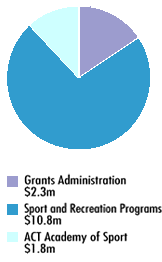
Sports and Recreation — 1999-2000 total expenses: $14.9m
1999-2000 Budget Highlights
- Combating Drugs in Sport ($60,000). To extend drug testing and education programs within the ACT.
- New Capital Works:
- Upgrade for Hockey Centre ($1.2m). An additional synthetic surface hockey field will be provided at the Lyneham Hockey Centre along with improved player and spectator facilities to provide a venue for major international and national events.
- Belconnen Pool ($1.2m)
- Mountain bike course at Blue Range ($205,000)
- Improvements to existing swimming pools ($300,000)
- Upgrading of sports grounds ($500,000)
Savings Measures
Spending on elite sport programs through the ACT Academy of Sport will be reduced by $100,000 through better targeting of resources and a reduction in the number of scholarships. The number of sports supported by the Academy will remain unchanged.
Did you know...
The 1999-2000 Sport and Recreation budget anticipates:
- 45,000 pool attendances;
- 70,000 hours of sportsground hire;
- 50 schools participating in the Active Australia Leadership Program;
- 290 top athletes on full scholarships through the ACT Academy of Sport; and
- almost 240 grants to sporting and recreation bodies, totalling more than $2m.
Access the ACT Government sports and recreation chart (opens image in new window)
Further information: Budget paper 4
Tourism — 1999-2000 total expenses: $12.2m
Up $0.6m (5%) on forecast outcome for 1998-99 due to increased funding for the marketing of the ACT as a tourist destination.
1999-2000 Budget Highlights
- Canberra National Multicultural Festival ($350,000) - Additional funding to further develop the tourism potential of the successful Canberra National Multicultural Festival, held for the first time in March 1999.
- Rally of Canberra ($300,000) - Extra funding to maintain the FAI Rally of Canberra as a round of the prestigious Asia Pacific Rally Championship, a major drawcard for motorsports enthusiasts.
- Olympic Torch Relay ($100,000) - To capitalise on the ACT leg of the Olympic torch relay, community events will be organised during the three days the torch will be in Canberra, from 5 - 7 September 2000.
Canberra and the 2000 Sydney Olympics
The 1999-2000 Sport and Recreation budget anticipates:
- As a venue for Olympic Football matches during the 2000 Sydney Games, Canberra will attract unprecedented international attention. Canberra Tourism and Events Corporation is working to maximise the economic benefits to Canberra from Olympic visitors.
- The ACT Government's commitment to making Canberra's role in the 2000 Olympics a success includes additional funding of $2m for marketing in 1999-2000, funding for events associated with the Olympic Torch Relay (see above) and $504,000 in 1999-2000 for Olympic security.
Further information: Budget paper 4
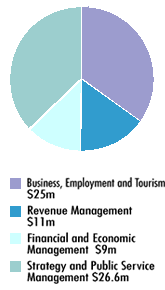
Chief Minister's Department — 1999-2000 total expenses: $71.6m
Up $9.3m (15%) on the forecast outcome for 1998-99 due to a range of new initiatives. The Department will achieve savings of $2m during 1999-2000.
1999-2000 Budget Highlights
ACT Promotion Centre ($1m)
To be built at Regatta Point overlooking Lake Burley Griffin, the new ACT Promotion Centre will showcase Canberra to business visitors. It will be developed cooperatively with the National Capital Authority.
Gaming and Racing Commission ($1.1m)
The Commission will commence operations on 1 July 1999, taking over the functions of the Casino Surveillance Authority and the racing, betting, gaming and lotteries functions of the Chief Minster's Department. A $500,000 Gambling Project Fund will provide research on the social and economic impacts of gambling in the ACT.
Very High Speed Train link to Sydney ($1.5m)
The ACT will meet one third of the costs of the "Proving Up" process and contract negotiations for this $3.5bn project.
Arts Funding
- Canberra Theatre modifications ($154,000);
- Feasibility study on a Contemporary Glass Centre ($30,000);
- Establishment of a Visual Arts Centre in the heart of the city ($167,000);
- Continued support for the Arts Development Funding Program.
Centenary of Federation ($500,000)
A total of $1.1m will be provided over the next three years to ensure Canberra is the centrepiece of activities to mark the Centenary of Federation in Australia.
Independent Competition and Regulatory Commission ($400,000)
To expand the role of the current Independent Pricing and Regulatory Commission to include investigation of competitive neutrality complaints and general oversight of the implementation of competition policy in the ACT.
Expanded Bill Paying Options ($512,000)
To provide a greater range of electronic payment options, with the aim of establishing a direct debit payment option by 1 January 2000.
Access the ACT Government chief ministers department chart (opens image in new window)
Further information: Budget paper 4
Business and Employment
Increasing job opportunities for young people
In 1999-2000 the ACT Government will offer new apprenticeships to 143 people, an increase of 6% on the 135 new apprenticeships offered in 1998-99. At least 25% of these positions will be for under 21 year olds, and 60% for people aged 25 or under.
The opportunities include:
- Park Rangers - 6 positions;
- Accelerated Data Capture program trainees - up to 12 positions;
- Graduate Administrative Assistants - 36 positions; and
- Traineeships in public administration and other training programs - 90 positions.
Employment Programs
A range of employment programs are being transferred from the Chief Minister's Department to the Department of Education and Community Services where they will complement existing Training and Adult Education programs. They include:
- Annual Employment Program - which provides entry level job skills;
- Security Industry Training Program for Indigenous people;
- Pathways into Non-Traditional Occupations - which encourages young women to enter trades and professions;
- Selfstart - a motivational program to improve the job prospects of the long term unemployed;
- Freshstart - a program for ex-remandees and ex-detainees of Quamby; and
- Upskilling - which upgrades the skills of over 25 year olds.
Increased funding for business development
The 1999-2000 Budget provides increased funding for two key business development initiatives:
ACT Industry Development Program ($250,000)
to provide small businesses with strategic planning consultancy services and advice on management, products, services and processes; and
Marketing Canberra as a business destination ($775,000 rising to $1.025m in the forward years)
to pursue a range of marketing initiatives including a direct marketing program, participation in trade shows, further development of a Canberra industry CD ROM, and stronger links with the education sector and with the Northern Territory Government under the NT/ACT Memorandum of Understanding.
Further information: Budget paper 4
ACT economic outlook
The ACT economy boomed in 1998, with State Final Demand, which measures spending in an economy, growing at a faster rate in the ACT than in any Australian state during the June, September and December quarters.
The ACT has now enjoyed nine consecutive quarters of economic expansion, producing a steady fall in the unemployment rate to levels not seen since the start of the decade. The growth has been surprisingly strong given historically low population growth (0.1%) during 1997-98. Business conditions in the ACT are positive, with low inflation, low interest rates and increased opportunities flowing from government outsourcing all contributing to high levels of confidence.
The forecast for 1999-2000 is for a year of consolidation in the ACT economy. The rate of economic growth will moderate before accelerating again in 2000-01. Population growth is forecast to rise gradually but remain below national growth rates for several years. The ACT Government will continue to pursue policies aimed at diversifying the economy by encouraging private sector expansion.
| Key Indicators (Percentage change on previous year) | 1998-99 Forecast | 1999-2000 Forecast | 3 year planning assumptions 2000-01 to 2002-03 |
|---|---|---|---|
| Gross State Product | 3.6 | 2.3 | 3.8 |
| Employment Growth | 1.2 | 1.4 | 1.5 |
| Consumer Price Index | 1.8 | 2.5 | 2.5 |
| State Final Demand | 4.0 | 1.9 | 2.7 |
| Population | 0.3 | 0.5 | 0.7 |
Further information: Budget paper 3, Chapter 2.1