
Introduction
This chapter reviews the ACT’s current economic conditions, outlines the ACT Government’s economic strategy and provides forecasts of major economic parameters for the Budget period. Indicative predictions of the components of State Final Demand are also included.
As in the 1998-99 Budget, analysis of the performance of the economy has been based primarily on the quarterly estimates of State Final Demand (SFD) published by the Australian Bureau of Statistics (ABS). Since the most widely accepted indicator of the strength of State level economies, Gross State Product (GSP), is not published in sufficient time for this Budget, estimates of GSP are only available for the 1997-98 financial year, and no quarterly data are available.
On the other hand, estimates of SFD for the States and Territories are published on a quarterly basis. SFD is a measure of the amount of spending that occurs in an economy, which is different from GSP, a measure of the production of an economy. SFD differs from GSP by the value of net interstate and international trade, and by the change in the value of stocks.
For the ACT, the level of SFD differs from GSP principally because the ABS does not recognise, as Territory exports, the value of public services which are produced in the Territory but provided to residents of other States. If they were treated as exports then the income earned by those exports (in effect, the taxes paid to the Commonwealth) would be included in the measure of GSP, and income as measured by GSP would be more or less equal to expenditure, represented by SFD.
Considerable caution must be exercised when using data from the ABS for the ACT. Due to the small size of the ACT, single transactions or small changes in the sample can create large variations. Some data series, which are available for other States, are not published for the ACT because of the ABS’s own concerns about their accuracy. As a result, it is considerably more difficult to obtain a complete and accurate picture of the ACT economy.
Overview
The ACT economy boomed in 1998, with State Final Demand (SFD) increasing at a faster rate than any Australian State in the June, September and December quarters. Only the Northern Territory enjoyed faster growth.
This illustrates the success of the Government’s strategy of creating and maintaining an attractive environment for businesses to locate here, and for existing businesses to grow and expand. It also demonstrates the inherent strength of the ACT economy, and the advantages of an increasingly diversified private sector underpinned by a strong public sector.
The public sector in particular has grown strongly during 1998, as the effects of the cutbacks which followed the 1996 Federal election have abated, and public spending has returned to its former growth path. This has taken the brakes off economic growth in the Territory, and indeed during 1998 the Commonwealth’s spending provided a boost to the economy.
In trend terms, the ACT economy has now enjoyed nine consecutive quarters of expansion. The economic slowdown that occurred during 1996 has long passed. Only the construction industry continues to experience the lasting effects of slower population growth, further exacerbated by the oversupply of the early 1990s.
The economic forecasts underpinning the 1999-2000 ACT Budget are summarised below.
Table 2.1.1
ACT economic forecasts
| 1997-98 | 1998-99 | 1999-2000 | 3 Year Planning Assumptions | |
|---|---|---|---|---|
| (Actual) | (Forecast) | (Forecast) | 2000/2001 - 2002/2003(b) | |
| Percentage change on the previous year(a) | (Average annual growth) | |||
| Gross state product(c) | 4.3 | 3.6 | 2.3 | 3.8 |
| Employment growth(c) | 0.7 | 1.2 | 1.4 | 1.5 |
| Consumer price index(d) | -0.7 | 1.8 | 2.5 | 2.5 |
| State final demand | 4.3 | 4.0 | 1.9 | 2.7 |
| Population | 0.1 | 0.3 | 0.5 | 0.7 |
(a) Based on original data currently available, with financial data expressed in real terms. Percentage changes are expressed in year average or year total terms unless otherwise indicated.
(b) The planning assumptions used in this document represent the estimated average annual change for the period 2000-01 to 2002-03. As such they do not represent expectation of actual annual changes.
(c) As at June each year.
(d) Represents forecast ‘headline’ CPI inflation which includes factors affected by policy changes, such as government charges and interest rates, and seasonal influences.
ACT current economic conditions
Economic Growth
The latest available figures for the ACT show that prior to the 1996 Federal election, the economy had already slowed from a high of 6.2% real trend GSP growth in 1993-94, to 3.7% in 1994-95 and 3.3% in 1995-96. The cutbacks in the Commonwealth public service caused a significant slowdown, with GSP increasing by just 0.3% in real terms during 1996-97. The most recently completed financial year saw a strong recovery, with growth of 4.3% in real terms recorded during 1997-98.
This recovery was achieved in the face of a population increase of just 0.1% during 1997-98. This meant that although the ACT’s economic growth of 4.3% was below the national average of 4.6%, the increase in GSP per capita was a substantial 4.2% in the ACT, compared with less than 3.4% nationally. Growth in GSP per capita is widely accepted as a measure of improvement in living standards. By this measure, the living standards of Canberrans improved more than for residents of any other State or Territory, other than WA, during 1997-98.
More recently, quarterly figures for SFD are available for the December quarter 1998. These figures show that over the twelve months December 1997 to December 1998 the ACT’s SFD increased by a massive 9.6% in trend terms, more than double the 4.5% national growth over the same period.
On a year average basis, trend SFD during 1998 averaged 6.3% higher than in 1997, well above the national average of 4.8%. This was second only to the NT, where growth was boosted to 20.1% by development of the Northern Endeavour gas facility.
Employment
Original series data from the ABS show that average total employment in the ACT in the first eight months of 1998-99 was 1.3% above the average level in 1997-98. The average unemployment rate for the first eight months of 1998-99 was 6.4%, compared with an average of 7.5% during 1997-98.
Population
Substantial recent revisions by the ABS to the ACT’s population statistics show that during 1996-97 the ACT’s population declined by 0.1%, compared with the ABS’ previous estimate of 0.5% growth. This turnaround is entirely due to a change in the method of estimating interstate migration. 1997-98 saw growth of 0.1%, and this is expected to pick up over future years as the improving ACT economy will reduce the incentive for people to migrate out of Canberra.
Business Conditions
Business conditions in the ACT are very positive. The national conditions of continuing low inflation and historically low interest rates are supplemented in the ACT by the lowest unemployment rate in nearly a decade, and the Government’s focus on reducing the costs of government to ensure Canberrans are not paying more than necessary for services.
The positive mood in business is reflected in surveys of business confidence such as the Morgan & Banks survey of employment intentions. The February survey showed that for the second consecutive quarter the ACT recorded the highest level of optimism in Australia. A net 28.2% of ACT employers expected to hire more staff in the three months to April 1999.
The ANZ Job Advertisements Series shows that the average trend weekly number of job advertisements for the first eight months of 1998-99 is 12.9% higher than in 1997-98. In February 1999, the trend series was at its highest level since March 1995, whilst the original series recorded its highest level ever, at an average of 518 job advertisements per week.
The Yellow Pages Small Business Index released in February 1999 found that a net 66% of ACT small business proprietors are confident about their business prospects for the coming 12 months. This is the strongest result the Index has ever recorded for the ACT since it first separately identified the ACT in October 1995.
Economic strategy
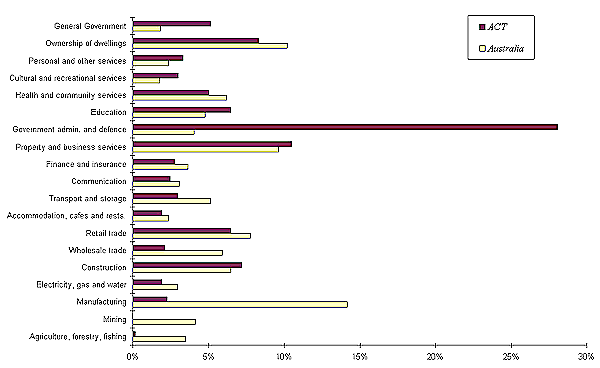
As the national capital and seat of Federal Government, the ACT economy has traditionally been dominated by the public sector, which accounts for a much greater proportion of the ACT economy than it does of the national economy. In 1996-97, the public administration and defence, general government, education, and health and community services sectors, ones in which the government typically has a significant presence, accounted for 44.7% of ACT GSP. This compares with the national average of 16.8% (refer figure 2.1.1).
Figure 2.1.1
Industry Share of GDP/GSP at Factor Cost, ACT and Australia, 1997
Source: ABS Cat No 5220.0, Tables 18C and 19C
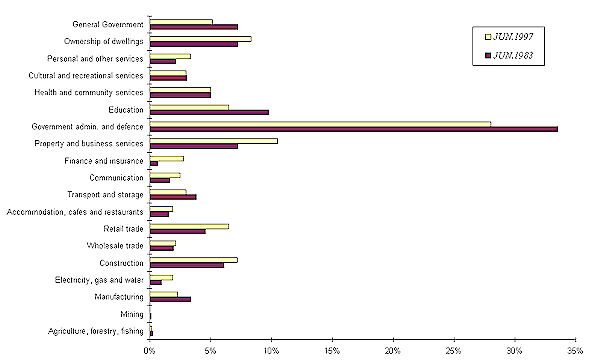
The reduction of the public sector’s importance in the ACT economy is illustrated by the reduction in the share of GSP represented by public administration and defence, general government, education, and health and community services over the period 1983 to 1997. In 1983 these sectors accounted for 55.5% of the ACT’s GSP, but by 1997 this had declined to 43.3% of GSP (refer figure 2.1.2).
While the public sector remains a source of strength for the ACT economy, the diversification of activity away from this sector is making the economy less vulnerable to changes in Commonwealth budget policies. With this in mind, the Government is still focussing on creating an environment that will encourage investment by both businesses and the household sector. This is being achieved through the dual strategy of ensuring that the economic fundamentals are conducive to greater private sector investment on a sustainable basis and, where appropriate, providing incentives targeted at the relocation and expansion of private sector firms.
Figure 2.1.2
Industry Share of ACT GSP at Factor Cost
Source: ABS Cat No 5220.0 Table 18C.
The Government’s economic strategy focuses on five key elements:
Diversification of the Economic Base
The impact of significant cutbacks within the Australian Public Service in 1996-97 underlined the need to stimulate private sector employment opportunities and reduce the dependency of the ACT economy on the Commonwealth. Key strategies have included actively working with major outsourcing companies to ensure outsourced jobs stay in Canberra and targeting industry sectors with strong growth potential, including information and advanced technology, corporate services and light manufacturing.
This Budget continues successful initiatives, such as the ACT Business Incentive Scheme, which are designed to create new jobs and support the private sector by providing a range of incentives for relocation, expansion or new business activity. The aim of these initiatives is to attract industries that can take advantage of Canberra’s highly educated workforce, its clean environment and proximity to the major population centres of Sydney and Melbourne.
The ACT as a Regional Economic Centre
Opportunities exist for enhancement of Canberra’s role as the economic centre of the south east region of NSW, servicing a population of over half a million. The successful purchase of the Canberra Airport by a locally based consortium, and the selection of the Speedrail consortium as the preferred tenderer for the Very High Speed Train link between Canberra and Sydney, are all part of this process.
During 1998-99 links with the regional economy have been further strengthened through the Australian Capital Region Leaders’ Forum and the Australian Capital Region Development Council.
The ACT’s geographical location, its importance as a regional economic centre and its proximity to Sydney all underline the need to maintain a competitive taxation system that does not create disincentives to investment or job creation. By keeping taxes generally in line with those that apply in surrounding New South Wales, the Government will help to maintain the competitiveness of ACT business.
Sound Financial Management and Service Delivery
Moving the ACT Budget from an operating loss into a sustainable operating surplus requires further expenditure reductions and the maintenance of revenue raising efforts, subject to the competitiveness issues outlined above. Sound financial management also requires that the Government constantly seek more efficient and effective methods of service delivery.
To that end, the major objectives of the financial reforms implemented by the Government are to:
- ensure that the optimum mix of goods and services is delivered to residents and businesses;
- ensure these goods and services are provided in the most efficient manner;
- provide best value for dollar for the community; and
- enable the community and business to have confidence in the Government’s management of the Territory.
To ensure greater accountability, the Government has implemented a financial reform program, focussing on:
- Government Outcomes, that is, benefits to the community; and
- Departmental Outputs, that is, appropriate quality goods and services which contribute to the desired outcomes and are provided by departments in the most efficient way.
The intention has been to shift the focus to results achieved and away from the traditional public service focus on resources consumed. The result is a clear separation in government of the purchaser role, the owner role and the provider role. These reforms enable the Government to specify the quantity, quality, timeliness, and cost of services and to identify opportunities for improved technical efficiency.
In addition, the Government is continuing to improve efficiency and introduce competition into the provision of government services, both to meet its objective of providing higher quality services at reduced unit cost to more people and as part of its obligations under the National Competition Policy Agreement. Comparative pricing was introduced in the 1998-99 Budget to identify the above and below average benchmark provision of major Government services. Agencies are also subject to a charge for use of capital. This ensures that the costs of services are more fully identified and, to the extent possible, are comparable with those faced by private sector firms.
The Territory continues to have very low levels of debt. The ACT’s level of general government debt is just 2.5% of GSP. This is lower than any other State or Territory with the exception of Queensland.
The Government’s financial management performance is reflected in the ACT’s AAA credit rating, the highest achievable, which was confirmed by Standard and Poor’s on 23 April 1999.
Creation of a Sound Business Environment
The Government is developing a business environment which positively encourages the operation of existing businesses and is attractive to potential new businesses. Government processes which adversely affect the performance of ACT businesses continue to be identified and either streamlined or removed. Proposals for new regulations are subject to Regulatory Needs Analyses, which seek to ensure that where regulations are adopted they are necessary, there are no better alternatives and that the regulatory cost burden is minimised. This aims to ensure that the level of ‘red tape’ imposed upon Canberra businesses remains minimal.
Proposals for new regulations are also examined to ensure that they would not constrain competition in markets and breach the Government’s obligations under the National Competition Policy Agreement.
Microeconomic Reform and National Competition Policy
The Government has strongly pursued the reforms associated with national competition policy. The main thrust of microeconomic reform is to make government business activities commercially competitive as a means of improving efficiency, and to increase competition and therefore value for the provision of government goods and services. Implementation of microeconomic reform creates a more level playing field when government and private businesses compete leading to decisions on investment and service delivery which contribute more to community well-being.
The Government aims to ensure that government activities are provided in the most efficient manner, in order to achieve the best value for money in purchasing services, the maximum return on investment and the greatest range of choice for consumers. Such an environment stimulates employment and economic growth and diversity.
Full application of competition policy to the public sector, through mechanisms such as comparative pricing, will result in reformed administrative and management structures and improved costing and pricing arrangements. This will deliver benefits to the community in the form of higher standards of service, better use of resources and reduced costs.
The ACT’s ongoing review of regulatory restrictions, and the major national reforms in the electricity, gas, water and transport industries, will deliver further significant benefits to business and consumers.
Economic forecasts
Gross State Product
GSP is the principal measure of aggregate economic performance at the State and Territory level. GSP estimates the total value of goods and services produced in the economy.
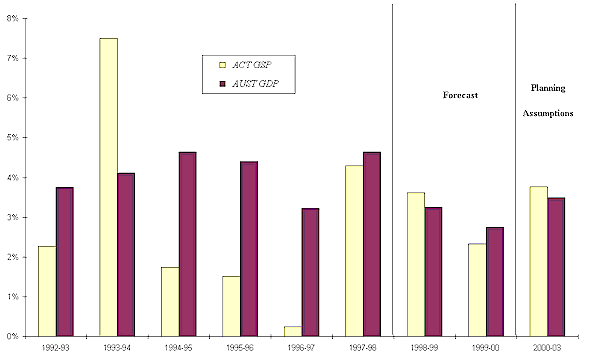
Figure 2.1.3
Real Annual Change in GSP/GDP, ACT and Australia
Source: ABS Cat Nos 5220.0 & 5206.0 and OFM and Commonwealth Treasury forecasts.
The 1998-99 Budget underestimated the strength of the ACT economy (although at the time it was criticised from some quarters for being overly optimistic), and virtually all of the growth that was expected over the two year period 1997-98 to 1998-99 was achieved in the first year alone. Economic growth in 1998-99 is expected to remain high at around 3.6%. This is slightly lower than in 1997-98, as the economy consolidates the gains made over the past year.
Growth is likely to slow further into 1999-2000 to around 2.3%, in line with the forecast national slowdown, before picking up again in 2000-01. An average of 3.8% is expected from 2000-01 to 2002-03, as increasing population growth allows GSP growth to accelerate on the back of increasing employment growth. The ACT will continue to experience relatively high levels of growth in GSP per capita.
State Final Demand
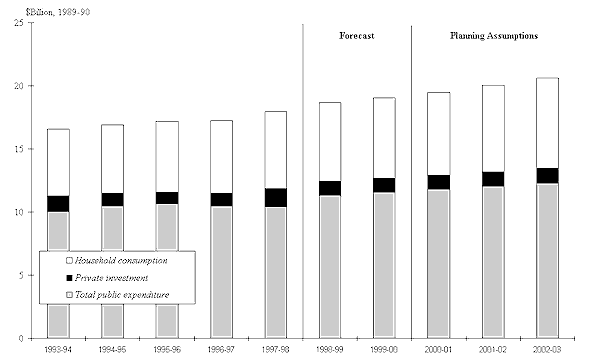
Total public expenditure (including consumption and investment) has accounted for a relatively constant proportion of SFD in the ACT, around 60%. This proportion peaked during 1995-96 at just over 62% before declining to around 58% during 1997-98. Despite reduced public investment during 1998 as a result of asset sales, increased public consumption spending will push this proportion back up to 60% during 1998-99. Growth is expected to reduce to 2.1% in 1999-2000 and an average of 2.0% per annum through the forward years.
Private consumption boomed in 1997-98, increasing by 6.0% despite the declining population. This growth will be consolidated in 1998-99 and 1999-2000 before again picking up through the forward years. Average growth of 3.9% per annum is predicted from 2000-01 to 2002-03.
Private investment also boomed in 1997-98, increasing by a massive 45.3% as the private sector bought buildings, machinery and equipment from the Commonwealth. These purchases are continuing, although to a greatly reduced extent, into 1998-99 and 1999-2000, resulting in declines in total private investment in those years. Through the forward years, increasing underlying investment, particularly as the housing recovery gathers momentum, will see private investment growth averaging a predicted 3.7% per annum.
Figure 2.1.4
Components of ACT SFD
Source: ABS Cat Nos 5206.0, Table 26, 5206.0.40.001, Table 26 and OFM forecasts.
Indicative predictions of the components of ACT SFD are summarised below.
Table 2.1.2
Indicative Predictions of the Components of ACT SFD
| 1997-98 | 1998-99 | 1999-2000 | 3 Year Planning Assumptions | |
|---|---|---|---|---|
| (Actual) | (Forecast) | (Forecast) | 2000/2001 - 2002/2003(b) | |
| Percentage change on the previous year(a) | (Average annual growth) | |||
| Private consumption | 6.0 | 3.1 | 1.9 | 3.9 |
| Private investment | 45.3 | -25.9 | -0.2 | 3.7 |
| Dwellings | -7.5 | 0.0 | 2.8 | 4.4 |
| Other buildings and structures | 140.8 | -54.6 | -9.9 | -1.4 |
| Machinery and equipment | 68.1 | -28.9 | 0.0 | 3.6 |
| Intangible fixed assets | 11.5 | 11.0 | 6.0 | 8.6 |
| Ownership transfer costs | 5.2 | 3.7 | 3.6 | 4.0 |
| Total public expenditure | -0.5 | 8.7 | 2.1 | 2.0 |
| Public fixed capital | -77.5 | 299.2 | 3.2 | 3.9 |
| Public consumption | 3.6 | 5.3 | 2.1 | 1.9 |
| Total state final demand | 4.3 | 4.0 | 1.9 | 2.7 |
(a) Based on original data, with financial data expressed in real terms. Percentage changes are expressed in year average or year total terms unless otherwise indicated.
(b) The planning assumptions used in this document represent the estimated average annual change for the period 2000-01 to 2002-03. As such they do not represent expectation of actual annual changes.
Private Investment
Dwellings
The trend number of residential building approvals fell 22.9% during 1997–98 after a 13.1% reduction in the previous financial year. However, during the first seven months of 1998-99 the number of residential approvals has averaged 57.5% higher than during 1997-98, and the average value of approvals was 31.3% higher. The trend number of residential building approvals in January 1999 was the highest number since November 1994.
The trend number of housing finance applications has been increasing since April 1998. Coupled with the improvement in building approvals, this suggests that the residential construction market has bottomed and is now in recovery. There are already strong signs of recovery in the market for established houses, which will spill over into the market for new dwellings. Forecast increases in the rate of population growth and continued strong employment growth will further increase demand for housing, as will the continuing trend towards smaller households.
Private dwelling investment in the ACT is expected to remain steady in 1998-99 after a decline of 7.5% in 1997-98. Growth of 2.8% is predicted in 1999-2000, and average annual growth of 4.4% in the forward years as population growth accelerates.
Other Buildings and Structures
Private capital expenditure on other buildings and structures increased 140.8% in real terms in 1997-98 as a result of the Commonwealth sale, and the private sector’s purchase, of Discovery House, the R G Casey Building, Acton House and the ATO Offices in Belconnen. This will decline by an estimated 54.6% in 1998-99 and a further 9.9% in 1999-2000, as Commonwealth asset sales reduce. A further decline is expected in 2000-01 as the program of asset sales comes to an end, followed by gradual increases in the following two years.
However, it is difficult to forecast accurately the non-residential sector in the ACT, given its particularly uneven nature and the significant impact that individual projects can have. Proposed and continuing projects include:
- redevelopment/extensions to Tuggeranong Hyperdome;
- redevelopment and refurbishment of Woden Plaza;
- redevelopment of Section 41 in Manuka to include a supermarket, shops, offices, underground car parking, health facilities and residential apartments;
- Dickson Tradesmen’s Union Club motel;
- West Belconnen Football Club;
- soccer stadium at Belconnen Soccer Club, McKellar;
- new entertainment building at Gungahlin Lakes Golf Club, Nicholls;
- redevelopment of the Melbourne Building, City; and
- warehouse for bulk goods retail at Greenway.
Machinery and Equipment
As a result of the Commonwealth’s sale of DASFleet to the private sector during 1997-98, private sector investment on machinery and equipment increased by 68.1% in that year. A reduction of 28.9% is expected in 1998-99, although to a level that remains above the levels of the mid 1990s. Investment on machinery and equipment is expected to increase through the outyears, as the continuing positive outlook for employment and population growth maintains business confidence at its current high levels.
Intangible Fixed Assets
Investment in intangible fixed assets, such as software, continues to increase steadily, and is expected to continue to do so over the forward estimates period.
Population
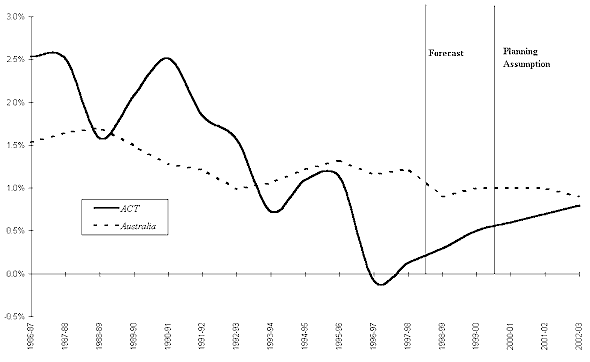
In June 1998, the ACT’s population represented 1.64% of the total national population. In the past decade the Territory’s population has increased by 13.3%, from 265,477 in June 1988 to 308,411 in June 1998. This compares with a national increase of 13.4% over the same period. The ACT’s population is expected to increase to 309,336 by June 1999.
The ABS has recently revised its estimate of the ACT’s population growth over the year to June 1997, from growth of 0.5% to a reduction of 0.1% (or 240 persons). As a result, last year’s population growth forecast for the year to June 1998 has since proved to be too high. Actual growth in the year to June 1998 was 0.1%, well below the forecast of 0.5%. Figure 2.1.5 shows that the Territory’s population increased relative to the rest of Australia between 1988 and 1993, recording a higher increase than nationally in all but one year. Thereafter the Territory’s rate of population growth has fallen below the national rate.
As a result of the increasing employment opportunities in Canberra, the flow of migration out of the Territory is expected to reverse in the medium term. In the meantime, Canberra’s population growth is being maintained by natural increase, although this is starting to slow. The Government will continue to diversify and develop the economy so that net interstate migration contributes to, rather than reduces, the rate of population growth in the ACT.
Figure 2.1.5
Annual Population Growth Rates, ACT and Australia
Source: ABS Cat No 3201.0, Tables 3H and 3I and Demography ACT & Commonwealth Treasury forecasts.
Labour Market
Labour Force
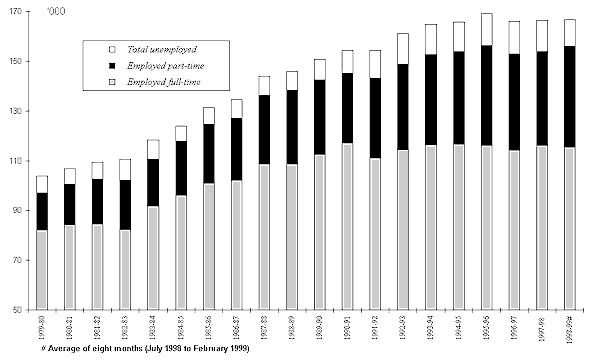
The Territory’s labour force increased by 0.7% in 1997-98, following a decline of 2.2% in 1996-97. Over the first eight months of 1998-99 it has increased by 1.3%. The ACT’s labour force participation rate declined from 71.5% in 1996-97 to 71.4% in 1997-98, and has averaged 70.9% for the first eight months of 1998-99. This remains significantly above the national rate of 63.3%.
The participation rate is expected to increase in 1999-2000 and future years, as the low unemployment rate and increasing employment opportunities result in the return of people who had previously left the labour market.
Figure 2.1.6 shows the size of the Territory’s annual average labour force for the period 1979-80 to 1998-99.
Figure 2.1.6
Average Annual ACT Labour Force
Source: ABS Cat No 6202.0, Tables 8H.
Employment Growth
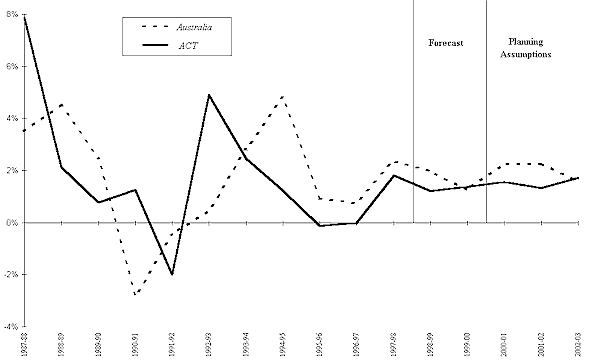
Employment is forecast to increase by 1.2% in 1998-99, following an increase of 0.7% in 1997-98. This is expected to accelerate further to 1.4% growth during 1999–2000. With the Territory’s unemployment rate already extremely low, those workers who have become discouraged over the past couple of years will be encouraged back into the labour force, hence increasing the participation rate. This will allow employment growth to exceed population growth over the forward years, although the strong economy and excellent employment prospects will contribute to a steadily increasing rate of population growth (see figure 2.1.7).
Figure 2.1.7
Annual Employment Growth Rates, ACT and Australia
Source: ABS Cat No 6202.0, Table 8, and OFM, Commonwealth Treasury and Econtech (2002-03) forecasts.
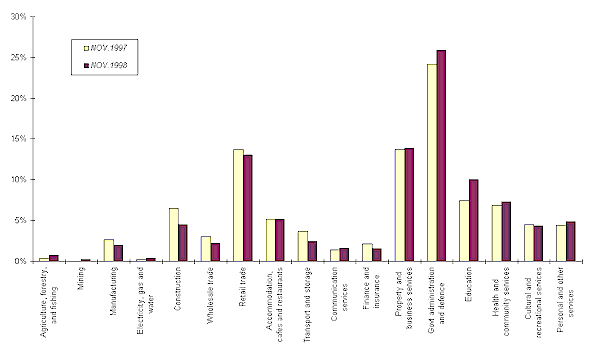
Government administration and defence, property and business services, and retail trade continue to be the dominant industry sectors, accounting together for more than 50% of the total number of employed. The greatest expansion in employment share over the period November 1997 to November 1998 was in education, with an increase of 2.6 percentage points. Government administration and defence also increased, by 1.7 ppts, partially reversing the decline of recent years. The greatest reduction in employment share was in construction, with a decline of 2.0 ppts, and transport and storage (-1.3 ppts) (see figure 2.1.8).
Figure 2.1.8
ACT Employment Share by Industry
Source: ABS Cat No 6354.0, Table 8I.
Prices
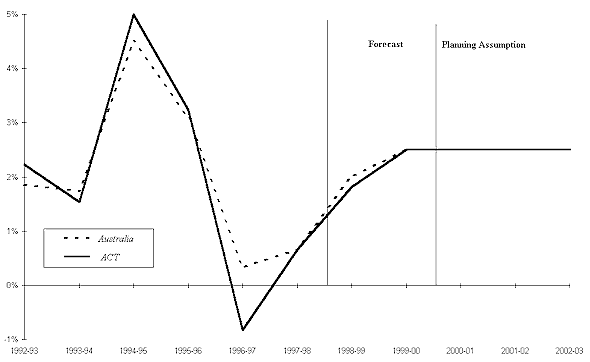
In line with the national trend, the ACT has experienced minimal inflation during the past two years. Prices reduced by an average of 0.7% during 1997-98, after increasing by 0.7% the previous year. However during the first half of 1998-99 inflation picked up, and prices have averaged around 1.5% higher than during the same period the previous year.
The increase in prices occurred across most product sectors other than transport, where costs fell by 1.6% in the year to December 1998. The greatest price increase occurred in relation to recreation and education, where prices increased by 3.9% over the same period, followed by food (3.4%).
Figure 2.1.9
ACT Employment Share by Industry
Source: ABS Cat No 6401.0, Table 1 and OFM and Commonwealth Treasury forecasts.
Wages
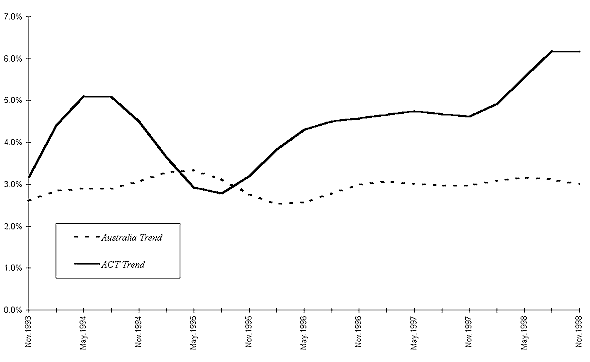
Together with changes in employment, changes in average weekly earnings (AWE) affect the levels of aggregate demand and economic activity. The ACT’s AWE during 1998 averaged 6.2% above 1997 levels, compared with the national growth rate in AWE of 3.0%.
Figure 2.1.10
ACT Employment Share by Industry
Source: ABS Cat No 6302.0, Tables 1 and 11.
The increase in AWE in the ACT has occurred despite a reduction of 12.6% in the number of overtime hours per employee. This was the result of a reduction in the percentage of employees working overtime of 1.5 ppts to 7.0% in November 1998, and a reduction in the average weekly number of overtime hours worked by those employees of 8.2% to 6¼ hours. Nationally the number of employees working overtime fell by 2.7 ppts to 15.6% in November 1998, and the average weekly overtime hours of those employees fell by 2.2% to 6¾ hours. Nationally, the net effect was a reduction of 6.5% in overtime hours per employee.