

A Message from the Chief Minister Introduction from the Minister for Social Inclusion Achieving Social Inclusion Safer Families Aboriginal & Torres Strait Islander People Culturally and Linguistically Diverse People People with Disability Children and Young People LGBTIQ People Older People Supporting Disadvantaged People & Families Mental Health Law & Justice Education
Supporting Disadvantaged people and families including Housing, Homelessness and Transport
The wellbeing of disadvantaged people and families is one of the most important responsibilities of governments and the wider community. The Government continues to implement important reform to the support service system for vulnerable children and families. Equal access to housing and transport are key to ensuring all Canberrans can fully participate in our community.
SERVICES WITH DIGNITY
Whole of government approaches through the Human Services Blueprint include a mix of prevention and early interventions initiatives to improve the way human services are delivered across Canberra. Specific measures also provide better homelessness support, referral services, and family support to ensure that all Canberrans are able to fully participate in strong, healthy and inclusive communities. The Blueprint is a long-term plan for community, health, education and justice systems to work together as one system.
Further to this the Government has been working to provide a cohesive service to our most vulnerable families:
- Three Better Services Initiatives have received a total of $3.2 million in funding over 2014-16 to improve how the government and community can work together to meet the needs of people facing significant life challenges.
- The Initiatives of Human Services Gateway; the West Belconnen Local Services Network; and Strengthening Families are working to achieve the Blueprint vision of increasing social and economic participation of all Canberrans.
- Strengthening Families - a Better Services flagship initiative focused on achieving service system improvements through greater coordination and integration of service access and delivery across the human services system:
- Strengthening Families has established the systemic supports required to authorise Lead Workers across programs and service systems to tailor service offers to meet the needs of individual families, and to address the barriers to achieving positive outcomes.
- To date the Strengthening Families program has supported 65 families, including 293 individual family members.
- Children aged 3-11 years make up 38% of participants with young people aged 12-18 years making up a further 17%. In addition, 31% of families identify as Aboriginal or Torres Strait Islander families, 14% of families were from a culturally and linguistically diverse background, and 52% of families were single parent households.
- The Better Services Local Services Network in West Belconnen through an innovative Collective Impact project in partnership with the Australian Research Alliance for Children and Youth (ARACY).
- A community owned scorecard will be co-designed with local residents to identify key measures of success in meeting the needs of local children and families. This project will contribute to the local priority areas- creating a better start for children, and building strong families.
- The project will enable local services to better meet the needs of disadvantaged children and families by targeting services and supports to areas of greatest need, and with the highest potential to create long lasting social change.
- An initiative under Better Services where local services and schools in West Belconnen will be working collaboratively to implement an Information Sharing Protocol which will enable services to support people with multiple needs without them having to tell their information multiple times. The Information Sharing Protocol will also support greater choice and control for people around how they tell and share their own information, including through an innovative My Family online profile tool due to be launched in the second half of 2016.
- The My Family program which will be complemented by an innovative ‘My Canberra’ online information portal also due to be launched in the second half of 2016. ‘My Canberra’ is an intuitive directory that supports individuals to find the right service, at the right time, and right for them. ‘My Canberra’ will also support social inclusion through connections to community groups, events, and facilities. For example, ‘My Canberra’ will assist with gaining access to information on peer based groups, sporting groups, festivals, and local community facilities.
- The Mobile Dental Clinic provides preventative and restorative dental services at aged care facilities, from a purpose-built mobile dental facility. The Clinic provides services to some of Canberra’s vulnerable people and those who have restricted mobility. The Mobile Dental Clinic aims to reduce barriers to access, such as cost and transport, and increase the levels of preventative and early intervention treatments provided to vulnerable groups.
- Through the 2016-17 Budget an additional primary health care service, like that established in 2014 at the Early Morning Centre at UnitingCare in the city will be established. The service will include GPs and/or nurse practitioners providing primary health care and links to further services on a regular part-time basis at a location that already caters for vulnerable people and/or on a mobile basis. Existing premises will be utilised, along with MBS and PBS funded GP services.
- A customer service platform within Access Canberra and additional online services will be facilitated to improve efficiency across the ACT public service and offer a better interface for customers of Government services.
- The commitment as part of the 2016-17 Budget to continue the Justice and Community Safety Directorate’s extended Throughcare program for one year with funding of $1.141 million. The Throughcare model provides assistance to detainees pre-release and for up to 12 months post-release. Detainees are assisted to overcome barriers around re-entry across five core areas: accommodation, health care, income, connections, and basic needs. This has a flow-on benefit to the detainees’ families and community.
- Free access is available to books, eBooks and other resources through Libraries ACT, loaning nearly three million items annually, as well as providing free access to computers, internet, internet-enabled devices and wifi. Library branches remain places of respite from weather conditions for homeless people, as well as a means for them to access services through the use of free technology.
- In February 2016, Libraries ACT held a Food for Fines campaign in partnership with OzHarvest Canberra. Library members with overdue items were encouraged to participate in Food for Fines and donate tins or packets of non-perishable food in exchange for fines being removed from their membership record. All food was donated to OzHarvest Canberra to provide support to charities across the region.
AFFORDABLE HOUSING
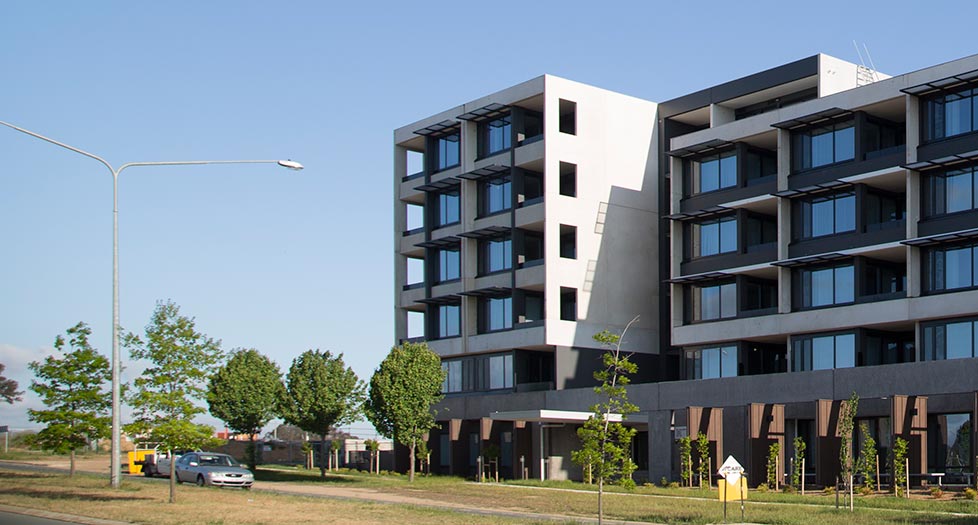
- Common Ground was developed to address homelessness in the ACT. Common Ground Canberra was completed in 2014-15. Common Ground creates a cohesive community in which people who were previously homeless can sustain long term accommodation. This is achieved through the coordinated delivery of stable accommodation with on-site and assertive support and by creating a ‘normalised’, inclusive community environment. All 40 units in Common Ground have been allocated to people who have previously experienced homelessness (20 units) and to affordable renters (20 units).
- Housing ACT continues to work closely with community and government support agencies to ensure tenants have the appropriate level of support to enable them to sustain their tenancies and to live, contribute and engage positively in the community.
- Increasing affordable rental housing and better targeting housing assistance to help low income households is a priority for the Government:
- The ACT Government is implementing taxation reform to reduce the cost of purchasing properties by abolishing stamp duty over a 20-year period.
- The 2016-17 Indicative Land Release Program which proposes a release target of 4,550 residential dwelling sites, with a grand total of 17,780 residential dwelling sites released over the four-year program supports the Government’s commitment to maintaining housing affordability in the Territory. The program also continues to make provision for a range of community land releases to provide housing options for an ageing population and for child care services. This program will deliver new housing supply above demand, keeping downward pressure on housing prices, accommodating the Government’s affordable housing targets and initiatives, and establishing an inventory of serviced land.
- Grants to low income households assist with the uptake of solar energy by overcoming up-front cost barriers. These grants allow low income households to realise the cost of living benefits of solar panel ownership.
- The Government has also made a submission to the Commonwealth-led Affordable Housing Working Group, as it seeks to identify potential financial and structural reform models to increase the national supply of affordable housing. Housing affordability is a national issue and it demands a national response. The ACT Government is interested in pursuing further multi-lateral and bi-lateral discussions with the Commonwealth and other jurisdictions; a national approach is vital to achieving delivery of effective affordable housing solutions.
- The Government will introduce a Disability Concession Scheme commencing from 1 July 2016. The Scheme will provide a conveyance duty concession to any entity (including individuals) who purchase a home to be used as the principal place of residence for a person with a disability. The intention is to encourage long-term private accommodation options for adults with a disability.
Public housing renewal
- The Government’s public housing renewal program is delivering the biggest upgrade to Canberra’s ageing public housing since self-government in 1989. The program will improve outcomes for public housing tenants with more sustainable housing that better meets their needs.
- Under the public housing renewal program the Government will build or buy 1,288 public housing properties to replace existing multi unit public housing along Northbourne Avenue and in other locations around Canberra. Significant progress has been made on this initiative, including commencing construction on over 350 new public housing properties, purchasing over 100 properties for public housing and engaging with existing public housing tenants to support them in relocating to improved accommodation as part of this program
- Renewing Canberra’s public housing portfolio means that the Government can: better support the needs of some of the most vulnerable people in our community; break down aggregations of disadvantage; and better integrate public housing and public housing tenants into the community. This investment
will see a greater level
of social inclusion and equality and mean that Canberra’s communities of the future will be sustainable
– environmentally, socially and economically.
THE BEST START
Provisions to support students in their training which are built into all ACT funded training initiatives. Skilled Capital, the ACT’s signature entitlement training program, and the Australian Apprenticeships (User Choice) program both provide loadings of $500 for registered training organisations to provide supports to a range of eligible students. Registered training organisations may also apply for further financial supports (up to $3,000 in some cases) to meet specific additional training needs of students.
ACCESSIBLE TRANSPORT
The ACT Government is also providing high quality and accessible public transport options:
- The Government is providing $1m in funding for the design and construction of upgrades to around 100 bus stops to meet Disability Standards. The upgrades will include improved wheelchair accessibility to bus stop boarding areas, tactile for vision impaired customers, and access paths.
- All new bus fleet purchases are to be Disability Discrimination Act compliant.
- The Special Needs Transport Service now delivers nearly 400 eligible students to 34 specialised and mainstream schools in the Canberra region, using 46 buses and 14 taxis.
- In 2014, the ACT Government established the Community Transport Coordination Centre as a one-stop shop for specialised transport services for people in our community who are at risk of social isolation due to a lack of access to regular transport services. This service will receive an allocation of $600,000 in the budget to meet the costs of an expansion of services into Gungahlin.
- The Aboriginal and Torres Strait Islander Community Transport services provide wheelchair accessible transport to local Indigenous people who are at risk of social isolation due to a lack of transport alternatives. The Service is staffed by a coordinator and an indigenous trainee, and receives recurrent funding of $190,000 in support.