
The Project Team needs to base the selection of the most appropriate project delivery model on objective analysis, using as full information as is reasonably available. When making the delivery model decision, the Project Team should keep an open mind and, at least initially, consider a range of potentially appropriate models. It is important not to presume in advance that a specific model would be the most appropriate or to bias the Project Team’s analysis of the available options.
In determining the appropriate delivery model, the Project Team should consider relevant evaluation criteria.
The figure below provides an overview of the process for assessing and selecting the most appropriate delivery model for a project. Unless stated otherwise, each step is required for all Tiers.
Overview of delivery model assessment process

Step 1: Data gathering
As above notes, the Project Team needs to base the selection of the most appropriate project delivery model on objective analysis, using as full information as is reasonably available. Hence, data gathering is an important step in the analysis. Most of the relevant data will be available from the analysis undertaken in other stages of project development for inclusion in the Business Case. It is important to validate the shortlisted delivery models by reference to benchmark projects, both domestically and internationally, and lessons learned from similar projects and delivery models.
In this step, the Project Team should also undertake a market assessment of whether the private sector has the ability and appetite to deliver the project. For Tier 1 projects and other non-Business-as-Usual projects, the Project Team may need to undertake a market sounding exercise as part of this assessment to obtain the views of potential project participants (see Market interest section). This process can help determine the market’s interest and ability in managing risks associated with the project, and it may inform how to structure the project to ensure the best possible outcome.
Key data requirements
The table below lists various questions that the Project Team needs to be able to answer to assess the different delivery models.
Data area | Key questions |
|---|---|
Project objectives |
|
Project requirements |
|
Project risks |
|
Project characteristics |
|
Packaging |
|
Market sounding
Typically only relevant for Tier 1 projects or non-Business-as-Usual projects
Government will require reliable information on which to base its decision on what are the most appropriate delivery models for shortlisting, particularly if it is considering any of the Integrated models. In part, this decision requires a practical examination of whether the private sector has the means to deliver the project, as well as the appetite and/or incentive to do so.
As part of the process of identifying and evaluating potential delivery models for a project, a market sounding exercise is an effective method that the Project Team can use to test and validate shortlisted options and to gauge the market’s likely response, with the added benefit of providing project pipeline visibility to private sector participants.
Ideally, the Project Team also should engage in preliminary dialogue with the private sector to learn more about current market conditions and trends, and the potential impacts of the project’s intended delivery model, as well as to give the private sector additional time to prepare to respond to Government’s requirements for a potential PPP project.
However, market sounding with the private sector normally is subject to probity considerations. The Project Team generally will determine a range of issues that it may discuss during the assessment phase of a project before commencing a market sounding process. Examples include:
- Project scope
- Project timelines
- Project-specific issues and requirements
- Market interest and capability.
Step 2: Shortlist delivery models
This step involves shortlisting delivery models based on a consideration of the scale, scope, risk, likely market appetite and whole-of-life service opportunities for the project.
For smaller or Business-as-Usual project (typically Tier 2 and Tier 3 projects), this process should be short and simple and rely predominantly on the prior experience of the Sponsoring Agency and iCBR. For example, the Project Team may already have a shortlist of two or three delivery models based on previous similar projects. For Tier 1 projects and other non-Business-as-Usual projects, the Project Team should undertake a more robust shortlisting process to identify up to four shortlisted delivery models using the process outlined below.
The table below sets out the key issues for groups of delivery models. These delivery models are explained in further detail in Outline of delivery models section.
Issue | User Charge PPP, | MC, | D&C, Document & Construct | PMA, |
|---|---|---|---|---|
Scale | ||||
Is the project value over $100 million? | ✔ | ✔ | ✔ | ✔ |
Is the project value under $30 million? | ✖ | ✖ | ✔ | ✔ |
Are there substantial lifecycle costs? | ✔ | ✖ | ✖ | ✖ |
Is the useful life of the project asset under 15 years? | ✖ | ✔ | ✔ | ✔ |
Scope and outputs | ||||
Are the project scope and outputs capable of clear definition in the tender documents? | ✔ | ✖ | ✔ | ✖ |
Is it feasible to measure the project outputs? | ✔ | ~ | ✔ | ~ |
Are design and construction complex, or does the project involve innovative technology? | ~ | ✔ | ~ | ✖ |
Is the scope likely to change in a way that the Project Team cannot anticipate? | ✖ | ✔ | ✖ | ✔ |
Are there any opportunities for bundling of non-core services and maintenance within the project? | ✔ | ✖ | ✖ | ✖ |
Risk | ||||
Is it possible to identify and quantify the main project risks? | ✔ | ✖ | ✔ | ✔ |
Are there unquantifiable risks and uncertainties that could have a material impact on the project cost and objectives? | ✖ | ✔ | ✖ | ✖ |
Is the cost of allocating the main project risks to the private sector likely to be prohibitive? | ✖ | ✔ | ✖ | ✔ |
✔ If the answer to the question is ‘yes’, these delivery models may be appropriate. If the answer is ‘no’, these delivery models may not be appropriate. | ||||
~ This question is unlikely to be important in determining the whether the delivery model is appropriate, but should be considered on a case by case basis. | ||||
✖ If the answer to the question is ‘yes’, these delivery models may not be appropriate. If the answer is ‘no’, these delivery models may be appropriate. | ||||
A tick against a group of delivery models for a question does not mean that other delivery models are not appropriate. That is to say, the group is particularly appropriate if the answer to that question is ‘yes’.
The Project Team must also consider the likely market appetite and ability to deliver the project, based on the market assessment or market sounding process undertaken in Step 1. For Tier 1 projects and other non-Business-as-Usual projects, the views of potential project participants may have a large impact on which delivery models may be appropriate.
Step 3: Select the recommended delivery model
Having identified and validated potentially suitable delivery models, the Project Team needs to identify the recommended model by evaluating each shortlisted model against the project objectives, using the relevant evaluation criteria and the rankings associated with the criteria (described in Evaluation criteria section).
The Project Team should use the evaluation template to evaluate the shortlisted delivery models and select the recommended delivery model. The evaluation template is shown in the table below and is also available on the Resources page under Business Case Templates. The Delivery model rating system table below describes the ratings for each criterion.
Delivery model evaluation criteria | Relative importance of evaluation criteria | Choose a model. | Choose a model. | Choose a model. | Choose a model. |
|---|---|---|---|---|---|
Project value | Choose an item. | [Insert short commentary and rating] e.g. ✔✔,✔,~,✖, or ✖✖ | [Insert short commentary and rating] e.g. ✔✔,✔,~,✖, or ✖✖ | [Insert short commentary and rating] e.g. ✔✔,✔,~,✖, or ✖✖ | [Insert short commentary and rating] e.g. ✔✔,✔,~,✖, or ✖✖ |
Project scope and duration | Choose an item. | [Insert short commentary and rating] e.g. ✔✔,✔,~,✖, or ✖✖ | [Insert short commentary and rating] e.g. ✔✔,✔,~,✖, or ✖✖ | [Insert short commentary and rating] e.g. ✔✔,✔,~,✖, or ✖✖ | [Insert short commentary and rating] e.g. ✔✔,✔,~,✖, or ✖✖ |
Ability to specify project outputs clearly | Choose an item. | [Insert short commentary and rating] e.g. ✔✔,✔,~,✖, or ✖✖ | [Insert short commentary and rating] e.g. ✔✔,✔,~,✖, or ✖✖ | [Insert short commentary and rating] e.g. ✔✔,✔,~,✖, or ✖✖ | [Insert short commentary and rating] e.g. ✔✔,✔,~,✖, or ✖✖ |
Time to deliver project | Choose an item. | [Insert short commentary and rating] e.g. ✔✔,✔,~,✖, or ✖✖ | [Insert short commentary and rating] e.g. ✔✔,✔,~,✖, or ✖✖ | [Insert short commentary and rating] e.g. ✔✔,✔,~,✖, or ✖✖ | [Insert short commentary and rating] e.g. ✔✔,✔,~,✖, or ✖✖ |
Flexibility | Choose an item. | [Insert short commentary and rating] e.g. ✔✔,✔,~,✖, or ✖✖ | [Insert short commentary and rating] e.g. ✔✔,✔,~,✖, or ✖✖ | [Insert short commentary and rating] e.g. ✔✔,✔,~,✖, or ✖✖ | [Insert short commentary and rating] e.g. ✔✔,✔,~,✖, or ✖✖ |
Price certainty | Choose an item. | [Insert short commentary and rating] e.g. ✔✔,✔,~,✖, or ✖✖ | [Insert short commentary and rating] e.g. ✔✔,✔,~,✖, or ✖✖ | [Insert short commentary and rating] e.g. ✔✔,✔,~,✖, or ✖✖ | [Insert short commentary and rating] e.g. ✔✔,✔,~,✖, or ✖✖ |
Innovation and incentive | Choose an item. | [Insert short commentary and rating] e.g. ✔✔,✔,~,✖, or ✖✖ | [Insert short commentary and rating] e.g. ✔✔,✔,~,✖, or ✖✖ | [Insert short commentary and rating] e.g. ✔✔,✔,~,✖, or ✖✖ | [Insert short commentary and rating] e.g. ✔✔,✔,~,✖, or ✖✖ |
Risk allocation to private sector | Choose an item. | [Insert short commentary and rating] e.g. ✔✔,✔,~,✖, or ✖✖ | [Insert short commentary and rating] e.g. ✔✔,✔,~,✖, or ✖✖ | [Insert short commentary and rating] e.g. ✔✔,✔,~,✖, or ✖✖ | [Insert short commentary and rating] e.g. ✔✔,✔,~,✖, or ✖✖ |
Market interest | Choose an item. | [Insert short commentary and rating] e.g. ✔✔,✔,~,✖, or ✖✖ | [Insert short commentary and rating] e.g. ✔✔,✔,~,✖, or ✖✖ | [Insert short commentary and rating] e.g. ✔✔,✔,~,✖, or ✖✖ | [Insert short commentary and rating] e.g. ✔✔,✔,~,✖, or ✖✖ |
Whole-of-life issues | Choose an item. | [Insert short commentary and rating] e.g. ✔✔,✔,~,✖, or ✖✖ | [Insert short commentary and rating] e.g. ✔✔,✔,~,✖, or ✖✖ | [Insert short commentary and rating] e.g. ✔✔,✔,~,✖, or ✖✖ | [Insert short commentary and rating] e.g. ✔✔,✔,~,✖, or ✖✖ |
Procurement and supervision costs | Choose an item. | [Insert short commentary and rating] e.g. ✔✔,✔,~,✖, or ✖✖ | [Insert short commentary and rating] e.g. ✔✔,✔,~,✖, or ✖✖ | [Insert short commentary and rating] e.g. ✔✔,✔,~,✖, or ✖✖ | [Insert short commentary and rating] e.g. ✔✔,✔,~,✖, or ✖✖ |
Stakeholder management | Choose an item. | [Insert short commentary and rating] e.g. ✔✔,✔,~,✖, or ✖✖ | [Insert short commentary and rating] e.g. ✔✔,✔,~,✖, or ✖✖ | [Insert short commentary and rating] e.g. ✔✔,✔,~,✖, or ✖✖ | [Insert short commentary and rating] e.g. ✔✔,✔,~,✖, or ✖✖ |
Overall rating | [Insert rating] | [Insert rating] | [Insert rating] | [Insert rating] | |
The main purpose of evaluating different procurement options is to identify the procurement method that will achieve the project's objectives while maximising value for money outcomes for the project.
The Project Team should base the framework to assess the shortlisted delivery models on agreed qualitative and quantitative criteria. Each criterion chosen should relate to how the delivery model will achieve the project's key objectives.
The framework described below bases the selection of a recommended model on Multi-Criteria Analysis (MCA) of the criteria described in the Evaluation criteria section. It uses ratings based on how effective the delivery model is in satisfying each criterion.
Rating | Description | Optional numeric equivalent |
|---|---|---|
✔✔ | Delivery model is highly effective in satisfying the criterion | 2 |
✔ | Delivery model is effective in satisfying the criterion | 1 |
~ | Delivery model is neither effective nor ineffective in satisfying the criterion | 0 |
✖ | Delivery model is ineffective in satisfying the criterion | -1 |
✖✖ | Delivery model is highly ineffective in satisfying the criterion | -2 |
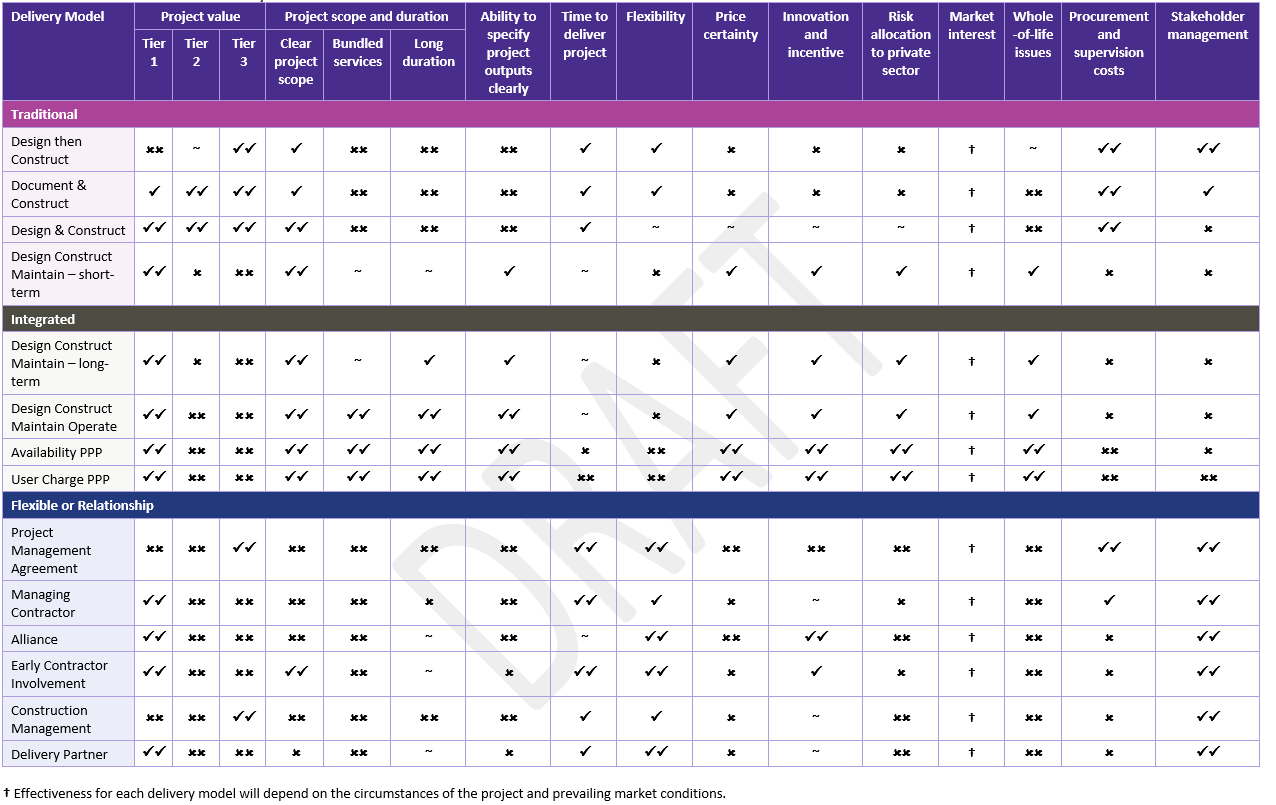
The table below provides an indication of the effectiveness of each delivery model against the evaluation criteria described in the Evaluation criteria section, using the rating system table above.
The relative importance of the criteria in below table (and described in further detail in the Evaluation criteria section) will depend on the characteristics of the individual project. The Project Team normally should use a three-point scale of relative importance: High, Medium and Low.
The Project Team may (but does not have to) translate these relative importance ratings into numeric weights to calculate a weighted total score for each delivery model. For example, the ratio of weights High: Medium: Low might be 3:2:1 or 5:3:1, or the Project Team could allocate percentage weights between the different criteria (the total of the weights always being 100%).
If using numeric scores and weights to give a total weighted score for each delivery model, the Project Team should undertake sensitivity analysis on the weights of the individual criteria to ensure that the selection of the optimum delivery model is robust and does not depend on the choice of weights.
Indicative effectiveness of delivery models
Footnotes: