A Clever, Caring Community
The ACT Government has a vision for the future of Canberra as a clever, caring community. A diverse community living in a city that is clever in the way it does business and seeks solutions; in its focus on high technology and education; that values fairness and opportunity and encourages a positive sense of belonging. A community that is safe, healthy and active, and a national capital that has a dynamic and sustainable economy.
The 1999-2000 Budget represents the next stage of the Government’s plans to realise these aims. While the budget papers themselves are focused upon the financial decisions that have been taken, this supplementary paper explores the reasons why the Government has taken these decisions and what we have already achieved towards meeting our goals.
The Budget presented today reveals that within two years, the ACT’s finances will be in surplus after more than a decade of deficits. While this is good financial management by the Government, it is not an end in itself. It is however, the means by which the Government can ensure that adequate resources are directed to where they are most needed and to ensure that future generations of Canberrans are not saddled with debts left behind by this generation.
Any government is constrained in what it can do by the amount of financial resources that are available. Therefore, a soundly based, rapidly growing economy and prudent financial management are the means by which the ACT Government can afford to provide the broadest range of high quality services to Canberrans.
Getting our house in order
Self-government, though unpopular when first introduced, has meant that we, as ACT residents, are now in control of our own destiny and must establish our own needs and priorities.
In the past decade, the ten Territory Budgets that have been compiled have recognised that as a community, we have continued to spend far beyond our means. To a greater or lesser extent, each budget has tried to limit spending while at the same time increasing revenue. It has been a difficult task, particularly against a background of a
49 per cent cut in real terms in Commonwealth funding to the ACT since 1989 and the loss of thousands of Federal public service jobs over that time.
Since this Government was first elected in 1995, it has set itself the task of getting the Territory’s financial house in order. The four Budgets we have brought down to date have been tough, but there remains a gap between expenses and revenue that must be addressed.
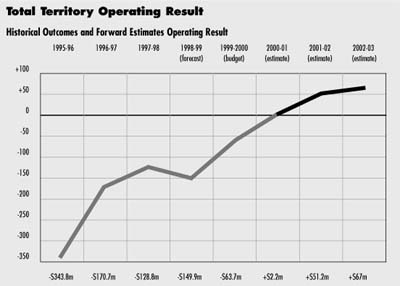
By way of example, the operating loss facing the ACT in 1998-99 means that expenses will be $149 million more than the amount which will be received as revenue. To bring the Budget into balance immediately would therefore mean reducing the amount spent on services by about $482 per person. Or, expressed another way, on a per household basis this works out at $1,355 extra revenue that would be needed.
There are few Canberrans who would volunteer to pay extra taxes, and probably even fewer who would be happy to see education, health and other services reduced by that amount. Yet most people would agree that the ACT cannot continue to spend more than we earn.
However, this tough stance is paying off. According to the Australian Bureau of Statistics, over the last year, the ACT economy has grown faster than every other state’s economy.
For the first time, the ACT Budget is moving into a genuine surplus in 2000-01. This is a tremendous achievement, particularly as it will occur four years ahead of the Government’s original timetable.
However, a surplus needs to be sustainable. This means that the surplus needs to be of a size at least sufficient to cover the capital works program and to guard against any unforeseen economic shocks in the future.
Without a sustainable operating surplus, borrowings (or potentially asset sales) would still be required to fund capital investment even if the Budget is in balance.
The Government has estimated that by 2002-03, the ACT’s operating surplus will be approximately $67 million which puts the Territory well on the way to a position of long-term financial sustainability. While this impressive turnaround in the ACT’s operating loss is good news, it will require careful management in order to ensure that it is achieved.
The conflict in community expectations
Accommodating these conflicting expectations - prudent financial management on the one hand and maintaining and improving the level and quality of government services without harsh taxation on the other - lies at the heart of the challenge facing the Government and the Legislative Assembly.
In the past three years, revenue has increased by 8.1 per cent while expenses have only increased by 1.9 per cent. At the same time, the ACT’s operating loss has been more than halved by the Government from $344 million in 1995-96 to about $149 million in 1998-99.
While eliminating the operating loss has been high on this Government’s agenda, the need for improved social and community outcomes has not fallen by the wayside. Indeed, responsible financial management is the only way that these outcomes have been and can continue to be achieved.
This Government therefore, has sought to carefully balance its approach to realising its goals of encouraging a clever, caring community while at the same time, striving to deliver the services that Canberrans need in a more efficient and cost-effective manner.
The planning framework
The results achieved by this Government have not occurred by accident. A great deal of strategic planning has already been undertaken which has looked at not only the next three years but well beyond that period into the 21st century.
The Government’s overall Planning Framework (Appendix 1) includes three levels of planning:
- strategic planning which sets out the Government’s longer-term vision;
- the Government Plan which provides outcomes and Key Result Areas to be achieved within its term to support that vision; and
- the annual budget process which sets out the specific outputs and performance measures which will contribute to the desired outcomes and Key Result Areas.
As highlighted earlier, the Budget is a key component of the Government’s overall strategy. It details what services the community can expect to receive during the year, what it can expect to pay for those services and what the expected financial outcome will be at the end of the year.
The purpose of such a plan is to ensure that services are provided in an agreed way to support and enhance the well-being of the Canberra community, and to provide a measurable basis for assessing how successful we have been in achieving our goals as a government and as a community.
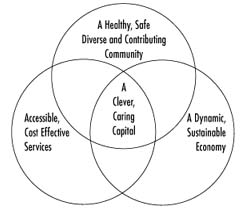
Last year, the Government published its plan for 1998-2001. It clearly identifies three outcomes that the Government is seeking to achieve in this term. They are:
- a healthy, safe, diverse and contributing community;
- a dynamic, sustainable economy; and
- accessible, cost-effective services.
These outcomes identify the areas where improvement will be made and value added to the community as a result of Government strategies.
Fostering a clever, caring community
To be clever, we need to be at the leading edge of change and we need to harness our city’s intellectual, social and financial resources. To be caring, we need to ensure that the services that are provided are not only accessible but also flexible and affordable for all Canberrans.
Our approach has recognised that these aims could not be achieved overnight but we have already taken significant steps towards making this vision a reality. They are about modernising the ways we deliver services, communicate with our citizens and do business with the world. And they are about providing assistance to the people in our community who need it most.
A Clever Community
The Government’s objective here is to ensure Canberra is a leader in Information Technology (IT) in Australia for both the public and private sectors by 2001. Initiatives to date have included:-
- provision for the introduction of electronic transactions. The ACT Government plans to have most Government transactions online by 2001;
- the establishment of the Office of Information Technology and Multimedia in the Chief Minister’s Department to coordinate technology management across the ACT Public Service;
- an electronic bill payment service established through a network of AUSTOUCH kiosks. AUSTOUCH kiosks, now in 19 locations around Canberra, are providing a full range of bill paying and Government information services, with water and electricity accounts being added to the list;
- electronic Commerce to offer huge opportunities for Canberra businesses:
- The ACT Government has provided $28,000 towards the establishment of the Australian Electronic Business Network (Ae.BN). Ae.BN will provide training workshops for Small/Medium Enterprise (SME) owner/operators to help them assess whether e-commerce is a viable option for their business;
- A further $30,000 has also been provided to raise the awareness of e~commerce and to encourage its usage by SMEs in the ACT;
- a functional directory to make contact with all Government agencies as simple and quick as possible. The directory is being piloted following the successful introduction during 1997 of the single ACT Government contact number (13 ACT 1) and the major overhaul of the ACT Government website at www.act.gov.au;
- innovative projects like ACTEW’s Broadband Communications Network (TransACT). The TransACT pilot in Aranda is part of a city-wide concept promising personal communications on a scale that is cheaper, quicker and more sophisticated than currently offered in any other city in the world;
- a significant upgrade of the ACT Government’s own IT infrastructure to improve customer service. The current IT infrastructure is increasingly inefficient and costly to maintain. The Government has allocated up to $80 million to address the Y2K problem and modernise technology and information systems across the public service. The modernisation program, which will be implemented by the end of 1999, involves the introduction of a fibre optic link between key ACT Government sites;
- comprehensive planning information available through the internet. The system, TPOnline, is the first in Australia to offer planning information through the Internet;
- provision of more than 2,000 computers to ACT Government school teachers. A further 1,000 computers will be provided by the end of June 1999. A total of 96 out of 97 Government and 34 out of 39 non-Government schools are now on the internet. 75 ACT schools are publishing on the web and 3,827 email accounts are provided to schools and staff;
- the Government plans to have 95 percent of Year 10 students certified in information technology competency by 2001. An IT competency assessment package is being trialled with a small group of students. A full trial of all Year 10 students will take place in 1999-2000;
- formation of the ACT Science and Technology Council in February 1998. The Council has 19 members representing academia, business, research and educational institutions and government and provides strategic advice to the Government on policies, priorities and programs aimed at accelerating the growth and stimulation of advances in science and technology, research and related development;
- provision of new websites and free training for eight community groups including the ACT Council for the Ageing, the ACT Council of Social Service, the Ethnic Communities Council, Shelter, the Health Consumers Association, Women with Disabilities and Disabled People International. The websites have proven to be a valuable community resource, especially for people with limited mobility;
- an ACT Health Communications Trial which is aimed at improving patient care through better networking and telecommunications by providing a communication bridge between the hospital, institutional and specialist sector and the primary health care and community based sector. The trial is regarded as a leading edge example of the clever use of technology in health care in Australia;
- pursuit by The Canberra Hospital of advances in technology specifically in relation to telemedicine. This initiative will allow the clinical expertise of the hospital to be accessed without the need to transport some patients from the region to the hospital;
- a variety of high-technology solutions have been introduced into the court system to increase efficiency such as advanced court recording and monitoring of Magistrates’ Court proceedings, a video link between the Belconnen Remand Centre and the Magistrates’ Court and on-line access to the Registrar-General’s Office;
- Seniors’ Internet Centres have been opened in Woden, Belconnen and Tuggeranong Libraries. Volunteers from the PC Users Group provide free training.
In 1999-2000:
- an additional $10 million for a program to upgrade the IT infrastructure for the ACT Public Service;
- $1.1 million for a major upgrade of Canberra's emergency services communications system.
A Caring Community
Poverty in Canberra
Canberra is often seen as an affluent society, but we who live here know that there are some members of our community who are in need. The Government is working with the ACT Council of Social Service to find out the level and nature of poverty in the ACT. Results will help the Government and the community to develop solutions to the problems, such as ensuring equitable distribution of funds.
A Healthy Community
Health Care Services
Health care in the ACT means much more than hospitals. The Government has worked hard to expand and improve our community health services and encourage preventative programs to ensure that all Canberrans can continue to enjoy a healthy lifestyle. Since 1995, the delivery of health care at the community level has included:-
- increased funding over the past four years to expand Home and Community Care (HACC) services to assist frail older people, people with disabilities and their carers who want to remain independent and live in their own homes;
- additional funding for public dental services to enable extra adults to be treated, following cuts in Commonwealth funding. All public clinics have now been expanded and re-equipped with modern technology;
- the introduction of new dental screening and oral health promotion programs in all schools. A new mobile dental service enables children to have their oral health assessed on site;
- refurbishment of Phillip and Kippax Health Centres;
- the construction of a new early childhood residential service in Curtin to replace the old QEII Hospital;
- two new purpose-built Family Care Centres in Lanyon and Ngunnawal, making a total of four family care centres across the ACT;
- the creation of the Territory’s first Hospital in the Home program. This program offers patients an alternative home-based service for the delivery of selected acute and sub-acute clinical services;
- a new Hepatitis C prevention and management strategy, allowing more Canberrans to access interferon treatment;
- the release of a Sexual Health and Blood Borne Diseases Strategic Plan, which provides a comprehensive policy framework for consolidating efforts to prevent and effectively treat HIV/AIDS and Hepatitis C;
- a new ACT Diabetes Service to improve the coordination of service delivery at all levels of care;
- the Territory’s first Asthma Support Service which works closely with GPs and specialists to provide ongoing support and education for families and individuals affected by asthma;
- the doubling of funds for health promotion activities in the ACT through the creation of an independent, professional agency known as Healthpact;
- the development of Australia’s first Co-ordinated Care Trial, a joint venture between the ACT Government and the ACT Division of General Practice;
- the ACT’s first Immunisation Strategy. The ACT has Australia’s highest childhood immunisation coverage rates in the country, with latest figures showing a coverage rate of 88.6 percent for infants who have been fully immunised by 12 months;
- the provision of free influenza vaccines for people over the age of 65, with funding for the vaccine made available by the Commonwealth and administration by the ACT;
- increased participation by women 50-69 years in the Breast Screening Program and the highest rate of cervical cancer screening in Australia;
- the creation of a new Health Protection Service which has brought together professionals working to protect the community from health risks arising from food, communicable diseases, drug use and environmental problems.
In 1999-2000:
- increased funding of $1 million under the Home and Community Care Program in the priority areas of respite care and in-home support.
Public Hospitals
The ACT’s two public hospitals, Calvary and The Canberra Hospital, have both been extensively upgraded in the past four years. Services have also been significantly expanded, ensuring that public hospital patients continue to receive the highest quality care. Examples of new facilities include:
- Canberra’s first adolescent unit, our first cardiac surgery unit and the first step-down, convalescent nursing unit;
- refurbished aged care and rehabilitation wards and improved pathology facilities;
- a new 15 bed independent living unit in Garran to provide a specialist rehabilitation centre in a community setting for people recovering from major accidents and injuries;
- a state-of-the-art renal dialysis unit adjacent to The Canberra Hospital to replace the ageing facility located on Acton Peninsula.
Examples of new and expanded services include:
- an additional $9 million over four years to fund extra operations for people waiting for elective surgery;
- extra funding to treat record numbers of patients at both public hospitals;
- a new Community Midwives Program which enables more than 250 women each year to access the service;
- increased specialist staffing in the Emergency Department at The Canberra Hospital, effectively more than doubling the number of hours in which specialists are available in Emergency;
- a dedicated telephone triage service for potential Emergency Department patients;
- new, improved discharge planning protocols to ensure better post-hospital care for all patients
- a new Public Hospital Patients’ Charter and a Charter for Public Health Service users;
- new wound management and continence promotion clinics to enable better co-ordination between hospital-based and community health services;
- an expanded role for the Canberra Clinical School, with new professorial appointments in Geriatric Medicine, Surgery, General Practice, Paediatrics, Mental Health and Trauma.
In 1999-2000:
- funding for the waiting times reduction program will be doubled by the provision of an additional $6 million; and
- an additional $1.5 million for quality improvement and safety practices, to enhance patient safety and treatment outcomes.
Mental Health Services
The Government has worked hard to improve the quality and availability of services for people with a mental dysfunction who are living and working in our community. Under the theme of "Moving Ahead", the Government introduced major reforms to redirect the focus of mental health services increasingly towards community-based support and intervention. This has included:
- an increase in funding of more than 10 per cent over the past four years for mental health services;
- additional funding to expand community based residential support for people with a mental illness;
- additional funding to provide respite care for children with mental health problems or for children whose parents have mental illnesses;
- expansion of the Mental Health Crisis Assessment and Treatment Team, with at least eight new positions created to enable the team to broaden its role to include treatment as well as assessment in the community;
- the release of a Whole of Territory Mental Health Strategic Plan, the first of its type for the ACT, which establishes a broad framework for the delivery of all mental health services;
- an ACT Youth Suicide Prevention Strategy - the first comprehensive strategy implemented by government to reduce the incidence of youth suicide;
- complete refurbishment of the old psychiatric services unit at The Canberra Hospital with funding set aside to construct a new, extended care secure facility;
- ongoing funding to support the Warren I’Anson Memorial Respite House which is managed by the Mental Health Foundation;
- closer co-operation between the AFP, ACT Housing and ACT Mental Health Service to improve responses to, and management of, mental health issues.
People with Disabilities
During the past four years, funding in this crucial area of community services has been increased by more than 30 per cent. The Government has worked hard to improve opportunities as well as services for people with disabilities who are living and working in Canberra. Examples of improvements include:
- introduction of a new, personalised system of direct funding, known as Individual Support Packages;
- construction of new community-group houses at Fisher and Macquarie;
- construction of a new residential unit in a semi-rural setting at Symonston;
- the establishment of two new Prolonged Care Cottages at Hughes in partnership with the National Brain Injury Foundation and the NRMA-ACT Road Safety Trust;
- two new respite care facilities to replace the ageing Biralee Hostel - Kese House and Teen House;
- funding for after-school and school holiday programs for families of children with a disability;
- easier parking arrangements for drivers with disabilities and their carers.
In 1999-2000:
- additional funding of $1 million to provide increased access for people with disabilities to high quality services.
Drugs
The Government has released a draft ACT Drug Strategy for public comment. The strategy aims to reduce the supply and use of harmful drugs while minimising the harm to the individual and society associated with the use of alcohol and other drugs.
Importantly, treatment services for drug-dependent youth and women are being significantly expanded with the provision of an eight-bed youth rehabilitation service and additional counselling and other support resources for the Women’s Information Referral and Education Service. The Government will contribute $1 million over four years to the youth rehabilitation service.
The Government has expanded the number of places available for people on the Methadone Program from 350 to more than 500 in the past four years. As well, new ‘safety packs’ have been introduced into the Needle Exchange Program which permit safer disposal of used equipment.
The Government is also collaborating with other States on trials of alternative drug treatments for people with opioid dependency. This includes the use of buprenorphine and naltrexone.
In 1999-2000:
- an extra 100 methadone treatment places will be established;
- Additional resources of $115,000 will be directed towards strengthening drug education in government schools.
Healthy Cities
The Healthy Cities Canberra program is building a foundation for achieving healthier communities by bringing together communities to address their priority health and quality of life needs. Health promoting schools, healthy hospitals, healthy workplaces and healthy neighbourhoods have been identified as four priority areas for action.
The Government is committed to sustainable development of the ACT. The "sustainable development" concept provides a framework for the Government’s initiatives in environmental and waste management; encouragement of enterprises focusing on education, research and high technology; and the focus on quality of life issues such as community safety and cultural and historical resources.
In 1999-2000:
- $300,000 to facilitate project development as a demonstration of the commitment to establishing Canberra as a healthy city.
ACT government school enrolments 1998:
- 4,000 preschoolers;
- 20,760 primary students;
- 10,600 high school students;
- 6,600 secondary college students; and
- 300 special school students.
Education
Canberrans have long been proud of their education system. The ACT has the nation’s highest retention rate and a college system that is the envy of other states. The Government has worked hard to ensure that education has been resourced to meet the needs of our children and views spending on our schools and colleges as an investment in the ACT’s future. This approach has seen significant improvements in the last four years, including:
- funding for government schooling has been increased in line with inflation in each of the last four years;
- general recurrent funding to non-government schools will be increased by a total of nearly 8% by 2002;
- expenditure on learning assistance in 1999 will total an estimated $5 million, an increase of 28% since 1995;
- annual assessments for literacy and numeracy in Government schools have been introduced. Assessments now take place in Years 3, 5, 7 and 9;
- additional funding of $400,000 has been provided for more intensive literacy assistance in the early years of school including reading recovery teacher training;
- a number of new Special Learning Support Units have been established including Macquarie Primary School Learning Support Unit, Wanniassa High School Early Childhood Centre, Wanniassa Hills Primary School Learning Support Unit (Autism Specific), Belconnen High School Learning Support Unit (Autism Specific), Latham Primary School. These new Units provide places for 40 students;
- a number of major school infrastructure projects have been completed, including:
- new high schools at Nicholls and Lanyon;
- access for people with disabilities at Campbell and Stromlo High Schools;
- the upgrading of science laboratories at several high schools;
- technology upgrades at Kambah and Caroline Chisholm High Schools and Lake Ginninderra College;
- a new hydrotherapy pool at Koomarri School.
- Grants for students with disabilities at non-government schools will be increased by $400,000 over five years. Schools received the first instalment of $100,000 for the 1999 school year.
In 1999-2000:
- For the fifth successive year, funding for both government and non-government schooling will be maintained in real terms;
- The first year of a three year program in high schools increasing the focus on contemporary and future learning needs including computer competency linked to employer needs.
Vocational Education and Training
- In 1998 there were 2,000 new apprenticeships commenced, an increase of 6.8 percent over two years.
- Between 1997 and 1998 the number of vocational courses available to students in secondary colleges increased from 10 to 26. More than a third of all college students now enrol in at least one vocational course.
- Canberra employers provided more than 2,000 college students with vocational placements in a wide range of industry areas in 1998.
Employment
Helping to generate new jobs has been a major objective of the Government during the past four years. These are being created principally in the private sector, producing a more diversified economy that is less likely to be significantly affected by any future changes in Commonwealth public sector activity.
- At 5.9 per cent, the ACT currently has the lowest unemployment rate for more than eight years, the second lowest rate of any Australian state or territory and the lowest number of unemployed Canberrans since 1991.
- Over the past year, 4,000 new jobs have been created in Canberra.
- A new, integrated package of training and assistance programs called "Pathways to Employment Opportunities" has been developed and introduced. This includes:
- ReStart, a pilot program that aims to employ up to 100 people aged over 40, based on the highly successful Youth 1000 program;
- New Futures in Small Business, a highly successful training program targeting older public servants who have been retrenched. A total of 98 people have completed the course in the past 12 months;
- a total of 100 extra places have been provided in basic computer, literacy and numeracy training courses.
- Closer links have been developed between several ACT schools and Canberra businesses through the Adopt-a-School program.
- The Self Start Program has been expanded. An extra 20 places for job seekers have been created in this challenging outdoors activity program which is designed to overcome low self esteem and motivation.
- New funding has been provided for a job skilling program for ex-detainees of Quamby.
- The ACT Graduate Administrative Assistance (GAA) program has increased by 25 per cent in the past year. 36 graduates commenced employment in 1999. The Scheme has almost tripled in size since its introduction.
- A new work experience program has been introduced. The Tertiary Student Development Program recently provided 14 Canberra university students with summer work experience in the ACT Public Service.
- New Graffiti Reduction, Data Capture and Trainee Rangers Programs within the ACT Public Service have also been highly successful.
Our Environment
Canberra is a unique city, where development has been integrated into the natural environment and where the urban design highlights the beauty of the Australian bush. Our mountains and bushland, hills and ridges, parkland, lakes and streams represent more than 70 per cent of the ACT’s total land area. Already, more than half of the Territory is protected by nature reserves.
Did you know the ACT has:
- Over 4,000 hectares of urban parkland, including 430 playgrounds and 590,000 trees;
- 100 park and city rangers and related staff.
The Government has worked hard to protect Canberra’s natural environment and enhance our reputation as a world leader in environmental management. We have been committed to managing the ACT in accordance with the principles of ecologically sustainable development and have pursued this at a local, national and international level. Some of the improvements have been:
- the development of the ACT’s first Greenhouse Strategy, making the ACT the first government in Australia to set targets to reduce greenhouse gas emissions;
- the protection of 500 hectares of native grasslands in Gungahlin and nine hectares of grasslands in Dunlop;
- the development of Australia’s most comprehensive environmental protection laws, governing all aspects of pollution, ozone protection and environmentally hazardous materials;
- the construction of a new visitors centre at Tidbinbilla Nature Reserve, along with three refurbished camping grounds, and improvements to walks and trails on Mount Ainslie and at Googong Dam, and local parks such as Point Hut, Weston and Margaret Timpson;
- the Territory’s first comprehensive waste management strategy, "No Waste by 2010";
- increasing the use of grey water together with the provision of a rebate for households which install domestic rainwater tanks;
- the ACT’s first Greenchoice electricity tariff scheme;
- implementation of the ACT House Energy Rating Scheme;
- the ACT’s first Nature-Based tourism strategy, together with an Environment Information Centre;
- a bushfire management plan outlining fuel management activities which will take place to minimise the potential impact of bushfires on human life and property;
- a bicycle strategy which has seen more than $1 million invested in construction of new bikepaths and upgrading of existing paths across Canberra.
In 1999-2000:
- A further $200,000 has been provided for a range of improvements such as construction of a new platypus education ‘hide’ at Black Flats Dam;
- $340,000 has been provided for implementation of the Greenhouse Gas Reduction Strategy; and
- $300,000 has been provided for weed control.
Sport and Recreation
Sport is a significant component of our lives in Canberra, even more so than the rest of the country. Our participation rate in sport and physical activity is the highest in Australia.
The Government has worked hard to encourage participation in sport and recreation at all levels, from schools right through to elite competition. We have supported initiatives such as the Active Australia Program which promote the health and social benefits for all Canberrans who exercise or play a sport. Some of the results of this approach have been:
- increased funding for the Sport and Recreation Development Grants Program;
- the introduction of scholarships for athletes with disabilities;
- construction of a new, indoor multi-sports centre, skateboard park and hockey complex in Tuggeranong and a new skateboard park in Civic;
- funding for the redevelopment of Manuka Oval as part of a major upgrade of Australian Rules and cricket facilities;
- plans for the development of a new indoor pool complex in Belconnen.
In 1999-2000:
- $1.2 million will be provided to build an additional synthetic surface hockey field at the Lyneham Hockey Centre along with improved player and spectator facilities in order to provide a venue for major national and international events; and
- Extra funding of $60,000 will also be provided to extend drug testing and education programs within the ACT.
Art and Culture
The Government recognises that a healthy cultural and artistic life is part of a healthy community and is keen for the ACT to be recognised as a national centre for excellence in the arts; a place to develop ideas and a place which cultivates its artists and their practice. This will make a major contribution to further establishing Canberra in the cultural tourism market. Among other developments:
* more than $3 million is directly contributed by the Government each year to arts in Canberra through the Arts Development Funding Program;
- more than $20 million has been spent on the construction of the new Playhouse Theatre, Canberra Museum and Gallery, the Tuggeranong Community Arts Centre and refurbishment of the Canberra Theatre;
- $2 million was provided by the Government for extensions to the National Gallery;
- a new Visual Arts Centre is to be established in the heart of Canberra, to be managed by Craft ACT;
- the Government has recently released Arts Capital, a new strategy which recognises and values the community’s commitment to the arts and aims to attract more business support;
- the Government has established the ACT’s first Public Art Program.
Housing
The availability of a wide range of quality affordable housing has been a priority for the Government which has sought to ensure that assistance is available to better meet the special needs of the ageing, young families, and people with disabilities. Our aim has been to provide greater housing choices in response to changes in demand.
The Government’s approach has been developed in the context of Canberra’s Housing: Strategic Directions for Housing in the ACT which established a strategic framework for housing in the ACT, particularly for Canberra’s rapidly ageing population.
- Over the past four years, more than $75 million has been spent on the ACT’s housing capital works program;
- Record funding has been provided for maintenance and general repairs to ACT Housing properties;
- During the next three years, an additional 200 units are being provided across the city, to house older residents;
- The Government has developed a strategy to rejuvenate or replace ageing housing stock and to manage larger multi-unit complexes. For example, a $4.2 million upgrade on the Allawah and Bega Flats has begun with all 228 two-bedroom units being upgraded over the next two years. Ainslie flats are being upgraded with the installation of heating and insulation and new hot water systems;
- Major redevelopments of Ainslie Village, Condamine Court and public housing at Charnwood have been completed;
- To allow more choice for low income tenants, management of 200 public housing properties have been transferred to Community Housing Canberra Ltd, a community-based non-profit organisation;
- A counselling service has been established to help public housing tenants who are having financial difficulties;
- Smoke detectors have been installed in more than 95 per cent of ACT Housing properties.
In 1999-2000:
- An extra $7.75m to upgrade public housing, including extra funding to build an additional 74 units suitable for older persons and refurbishment and improvements to better meet the needs of tenants.
A Safe Community
Community safety and confidence is a key concern of many Canberrans, and this Government has looked beyond the knee-jerk response of other jurisdictions which have simply chosen to ‘talk tough’ about crime without adopting new approaches. We have recognised that the causes of crime are complex and our efforts have been focused on developing a multi-faceted approach to combating crime.
Did you know the ACT has:
- Since 1997, safety audits have been conducted on 1,380 homes.
In April this year, there were:
- 13 ambulances plus 3 response vehicles;
- 12 fire trucks.
This has meant looking beyond policing alone and considering issues in a wider context, such as town planning to reduce the incidence of crime right through to education programs for Canberra’s young people about the harmful effects of misusing drugs. Some of the results of this approach have been:
- the development of the ACT’s first Community Safety Strategy;
- upgrading of lighting around major carparks and other sites around Canberra to improve security and safety;
- introduction of a new Firearms Act, giving the ACT the toughest gun laws in Australia. Through the gun buyback scheme, it is estimated that there has been a reduction of 25 per cent in the numbers of firearms in Canberra;
- encouragement of local community involvement in crime prevention through the Community Crime Prevention Council, an annual community grants program and ongoing support to such groups as the Manuka Safety Committee;
- a new Community Safety Liaison and Advisory Safety Project (CLASP) in partnership with the Council on the Ageing, the AFP, Fire Brigade and Ambulance services. Officers undertake inspections of the homes of older Canberrans and provide advice on home safety, fire risk, and other safety issues;
- secondary schools are now involved in a new ‘Adopt a Cop’ program, complementing the ‘Police in Schools’ program;
- restructuring of the Federal Police has enabled more than 40 extra officers to be put back on front-line duties during the past four years;
- a Domestic Violence Prevention Council has been established, accompanied by new laws to better protect and assist victims of domestic violence. Victims now have access to a Domestic Violence Protection Order at any time, including nights and weekends;
- the Government has funded the establishment of a new Neighbourhood Dispute Resolution Service;
- financial support has been provided for the Victims of Crime Assistance League (VOCAL) together with the establishment of a Victims of Crime Co-ordinator’s position;
- new facilities costing more than $20 million have been constructed, including:
- the Magistrates’ Court complex;
- Tuggeranong Police Station;
- AFP City Shopfront; and
- the Gungahlin Joint Emergency Services Centre.
- a new Southcare Aero Medical Rescue Helicopter service has been introduced, providing emergency medical evacuation services for the ACT and the south-eastern region of NSW;
- two additional ambulance crews have been provided, and response times are amongst the fastest in Australia. Combined with the efforts of the ACT Fire Brigade the ACT has achieved the lowest death rate from fires in Australia;
- the timetable for the construction of the ACT’s first prison has been announced;
- periodic detention has been introduced as an alternative to full-time imprisonment.
In 1999-2000:
- $1.5 million funding for the Woden Joint Emergency Services Centre;
- a further $1.1 million to upgrade Emergency Communications;
- $3.056 million to increase the capacity of the Belconnen Remand Centre and for increased prisoner payments to NSW;
- additional $1.7 million to fund wage increases granted to the AFP by the Commonwealth.
A Diverse Community
Canberra is a city of many languages, cultures and traditions. One in every seven residents was born in a non-English speaking country and more than 13 per cent speak a language other than English in their homes. For many of these people it is difficult enough to adjust to a new way of life in Canberra without having to face the additional difficulty of gaining access to services.
The Government has worked hard to ensure that these services and access to assistance have been readily available to people, regardless of their communications skills or their background. We are committed to the principle that every Canberran has the same right to participate in the life and development of this city. Our efforts have resulted in:
- the establishment of a dedicated office of Multicultural and International Affairs within the ACT Public Service;
- the development of the ACT’s first Interpreter Card;
- the production of an Information Booklet for New Settlers in eight languages, designed to help new arrivals to Canberra settle in;
- the first-ever Directory of Multicultural Resources in the ACT;
- an Ethnic Community Grants Program;
- additional funding for the Migrant Resource Centre and CIT to provide specialist language and support programs for new migrants;
- the ACT’s first anti-racism strategy;
- a Multicultural Consultative Council which provides advice directly to the Chief Minister;
- the creation of the Canberra National Multicultural Festival which is held every year.
Children and Youth
Canberra has, on average, a much younger population than the rest of Australia, with one quarter of the population aged between 12 and 25. The Government has taken an active role in seeking out the views of young people, and providing them with relevant information and, where necessary, support to help meet their needs. Steps we have already taken include:
- the establishment of a new youth health service in Civic, ‘The Junction’ backed up by the release of a Youth Health Strategy;
- the creation of a new Ministerial Youth Advisory Council, a Youth Connections Program and a Youth Education Access Program at Civic Youth Centre;
- record funds for the Youth Services grants program during the past four years;
- direct ACT funding for the Gugan Gulwan Youth Aboriginal Centre in response to the withdrawal of Commonwealth funding;
- a protective behaviours program, provided in all government schools, to assist young people to deal with unsafe situations, addressing issues of abuse (physical, sexual and emotional) in a sensitive manner and teaching strategies in primary prevention;
- development of the ACT’s first Youth Suicide Prevention Strategy;
- introduction of mandatory reporting of suspected or actual child abuse.
In 1999-2000:
- an extra $573,000 for the protection of children at risk of abuse;
- $400,000 to improve management and operational arrangements at Quamby;
- $500,000 for the part-construction of the Gungahlin Community Resource Centre;
- $390,000 for the part-construction of the Lanyon Neighbourhood and Youth Centre.
Older Canberrans
Canberra’s population is rapidly ageing. The number of people 65 years and older is expected to more than double in the next 15 years. This changing population profile is placing far greater demands upon the government to provide services and policies that address key issues such as retirement incomes, health, home and community care and transport.
Older people contribute not only to the economic wellbeing of our community, they also have a wealth of skills and experience to share. They often care for people who are young, sick or disabled, and also give up their time to work in community organisations, sporting groups and charities as volunteers.
In 1995, the Government released a Three-Year Forward Plan for older people which outlined a strategy for helping to meet the needs of the 28,000 Canberrans aged 60 and over. Our efforts, which have been built around this plan, have included:
- additional funding to expand the Home and Community Care (HACC) Program of more than 30 per cent during the past four years;
- increased support for respite care services and the HandyHelp program;
- establishment of a Carer’s Resource Centre in Canberra;
- additional funding to the ACT Council on the Ageing to manage the Seniors Card Scheme;
- a range of discounts on motor vehicle registration for pensioners and holders of Seniors Cards;
- funding to support a variety of activities taking place during the International Year of Older Persons (IYOP) in 1999.
Indigenous Peoples
The Government recognises the history of Aboriginal and Torres Strait Islander habitation of Australia, and particularly of the ACT region. In 1996, the Territory’s Indigenous population was estimated at 2,898 or one per cent of the total population. This represents an increase of more than 80 per cent since the previous census in 1991. Examples of the initiatives taken by the Government during the past four years have included:
- a three-way agreement between the ACT Government, Commonwealth and ATSIC to improve service delivery and coordination in Aboriginal health services in Canberra;
- new initiatives in health and childrens’ services in response to the release of the Bringing them Home report;
- the introduction of a specialised Security Industry Training Program which provides on the job training in security work for Aboriginal and Torres Strait Islander people;
- training and recruitment of Indigenous carers for children requiring care outside their family is a priority for the child protection system. The Indigenous Placement Principle, which requires Indigenous children being placed in out of home care, to be placed with a member of their family, their community or an Indigenous carer, will be included in legislation to be introduced this year;
- the ACT Aboriginal and Torres Strait Islander Cultural Centre on Acton Peninsula is due to open in 2001. Funding for its construction was provided by the ACT Government.
In 1999-2000:
- $70,000 will be provided to fund the establishment of a new ACT Aboriginal Justice Advisory Committee.
Women
This Government has maintained its commitment to improving the status of women in the ACT through initiatives including:
- support for greater representation by women in decision making forums. Women now make up more than 40 per cent of the membership of all ACT Government boards and committees, the highest proportion in Australia. Women also occupy more than 30 per cent of all senior executive positions in the ACT Public Service;
- an audit of ACT Government programs to see how well they are meeting the needs of women. The results will indicate how well ACT women as customers are being served by the government and will inform the development of the ACT Women’s Action Plan;
- the ACT Women’s Consultative Council, which assists the Government to develop and implement policies to advance the status of women by acting as a link between women in the ACT and the Government and conducting community consultations to identify relevant issues;
- an ACT Women’s Homepage on the Internet which was launched this year and provides information on the range of services available to women and relevant current policy issues;
- continued support for the Women’s Information and Referral Service;
- maintenance of links with and support for the ACT Chamber of Women in Business. Women returning to the workforce are a priority target group for employment programs, particularly courses which aim to increase information technology skills; and
- a Redundancy Information Kit which provides a range of relevant information for women who have taken or are considering taking a redundancy package.
A Contributing Community
Volunteers
Volunteers in the ACT are an invaluable resource to hundreds of organisations, large or small. They are found in a wide range of areas, including health, welfare, education, the arts, sport and recreation, tourism, emergency services and the environment.
The Government has been keen to raise the profile of volunteering in Canberra and has provided direct funding of $100,000 to Volunteering ACT as the peak body which represents volunteers in the Territory.
A Dynamic, Sustainable Economy
The Government is proud of its achievements in economic management, which have contributed to the ACT’s high income and living standards. According to a snapshot of Canberra released by the Australian Bureau of Statistics earlier his year:
- the ACT had the highest household income per capita of all states and territories;
- Canberra-Queanbeyan had the third-highest labour force participation rate (71.1%) next to Darwin and Cairns;
- private sector employment now constitutes more than 55 per cent of total employment in the ACT.
Did you know the ACT Government is responsible for:
- 7,600 lane kilometres of roads and paths and 58,000 street lights;
- 3,000 kilometres of stormwater pipes and channels;
- 1,000 bridges and major culverts;
- over 9 million household garbage and recycling bin collections each year and disposal of 238,000 tonnes of waste;
- cleaning services to 80 shopping centres and 62 public toilets;
- litter collection from 50 kilometres of major arterial roads.
Tourism
Tourism is one of the ACT’s major potential growth industries. Nearly 10,000 full and part-time jobs in Canberra are supported by tourism.
During the past four years, the government has revitalised the Territory’s marketing and promotional efforts and refocussed them to better target key domestic and international markets. Initiatives in this important area have included:
- additional funding of $6 million over three years to the Canberra Tourism and Events Corporation to market Canberra as a tourism destination and to capitalise on the opportunities arising from the 2000 Olympic and Paralympic Games;
- the establishment of the ACT’s first convention loan scheme which is designed to attract more conferences to Canberra;
- revitalisation of major festivals such as Floriade, the Canberra Rally (now part of the Asia Pacific Championships) and the Canberra National Multicultural Festival (incorporating the old Canberra Festival);
- construction of a new Canberra Visitors’ Centre.
In 1999-2000:
- $1 million to build an ACT Promotion Centre at Regatta Point to showcase Canberra to visitors;* $350,000 to further develop the tourism potential of the Canberra National Multicultural Festival,;* $300,000 to maintain the FAI Rally of Canberra;* $100,000 to allow community events to be organised during the three days that the Olympic Torch will be in Canberra.
Business
The Government is committed to reducing Canberra’s reliance upon the Commonwealth public sector for economic and employment growth so that our city will be better protected from any future downsizing and spending cutbacks by federal governments of either political persuasion.
There are more than 13,000 small to medium sized businesses operating in the ACT, employing about 55 per cent of our workforce. During the past four years, the Government has been committed to doing all it can to create the right economic climate, assist businesses directly, remove obstacles to job creation and growth, and to make it easier for businesses to get the help they need from government.
Our efforts have seen confidence among small business operators reach its highest level in three years, while ACT firms continue to win the greatest share of Commonwealth outsourcing and purchasing contracts. Initiatives that we have undertaken include:
- the development of the ACT’s first Industry Strategy, Creating our Future;
- an integrated package of programs to support business growth in the ACT under the title of Pathways to Successful Business Development;
- the creation of CanDeliver, a territory owned corporation, to try and win Commonwealth outsourcing contracts and pass this work onto ACT small businesses;
- an ACT Business Licence Information Service;
- a Canberra Business Development Fund, a joint public-private project, which provides capital to innovative Canberra companies to help them turn innovative ideas into profitable businesses;
- an ACT Business Incentive Scheme which provides payroll tax deductions, land grants and other incentives to encourage businesses to establish new operations or expand in the ACT;
- the New Enterprise Loans Guarantee Scheme offers (government guaranteed) loans to a maximum of $10,000, at a reduced rate of interest, to graduates of accredited business training courses such as New Futures in Small Business;
- the establishment of an ACT Industrial Supply Office which provides local industry with the opportunity to supply products and services to major contracts both locally and interstate;
- an increase in the threshold for payroll tax from $550,000 to $800,000 since 1995 which has enabled more than 100 ACT firms to be totally exempted.
Improving Regional Infrastructure
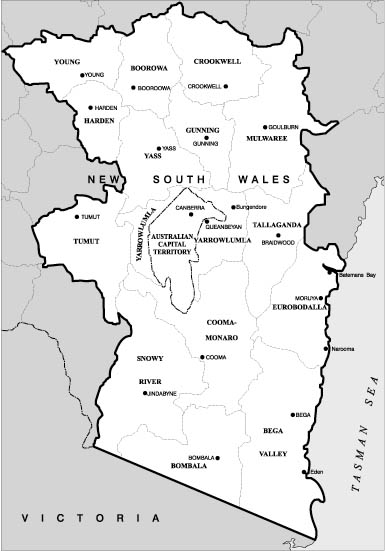
- The Government continues to work closely with the Commonwealth and New South Wales Governments and the 17 surrounding local councils to improve infrastructure and transport links within the region;
- The development of a high speed train link from Sydney to Canberra, the upgrade of Canberra Airport to international status and improvements to major highways in the region, all contribute to the strength and flexibility of the ACT economy.
A sustainable future
The information presented above represents just some of the steps that the Government has taken towards fostering a clever, caring community.
Everyone who pays an ACT tax or enjoys a service funded by the ACT taxpayer has a stake in ensuring that the Territory’s finances are put on a sustainable footing. The 1999-2000 Budget is the next instalment in that process.
Ten years after self-government, the ACT is meeting the challenge of paying its own way. While the transition has been difficult, this paper has clearly demonstrated that the Government has not pursued a balanced budget at the expense of its community obligations.
The dividend from this approach is a clever, caring community.