
Current and Future Developments in Intergovernmental Financial Relations
Introduction
This chapter outlines developments in the ACT’s financial relations with the Commonwealth, states and the Northern Territory that occurred in 1998-99. The likely flow-on effects into 1999-2000 and possible developments in the outyears have also been foreshadowed.
The capacity and flexibility of the states and territories to address their own budgetary priorities continues to be impaired by the disparity between the revenue raising powers and expenditure responsibilities of the Commonwealth and the states. The dependency of the states and territories on Commonwealth funding is referred to as vertical fiscal imbalance.
However, the environment of Commonwealth-State financial relations is set to change dramatically due to the proposed implementation of the Goods and Services Tax (GST) under the Federal Government’s major tax reform package. Although the GST is yet to pass through the Senate, all state and territory leaders signed a new Intergovernmental Agreement on the Reform of Commonwealth-State Financial Relations at the recent Premiers’ Conference.
The major change in Commonwealth funding to the states and territories arising from the proposed tax reform, is that all of the GST revenue will be handed back to these jurisdictions, replacing Financial Assistance Grants as the major source of Commonwealth revenue to the states and territories. This will be conditional on the states abolishing nine inefficient taxes such as financial institutions duty, debits tax and various stamp and conveyancing duties and funding the First Home Owner’s Scheme and local government.
Quite apart from changes flowing from tax reform, significant changes to the distribution of general revenue assistance to the states and territories have followed a major review of Commonwealth Grants Commission methods. For the ACT, the impact of these changes will be positive in 1999-2000. In this context, recent intergovernmental highlights for the ACT are as follows:
ACT’s Transition to State-Like Funding
- In the context of the ACT’s transition to state-like funding, the ACT made considerable progress in maximising the opportunities to secure additional funding for 1999-2000 through the Commonwealth Grants Commission process. Indeed, the transition to state-like funding is now complete with the final payment of special revenue assistance for health and education ceasing in 1998-99.
Commonwealth Grants Commission 1999 Review of Methodology Outcome
- On 3 March 1999 the Commonwealth Grants Commission released its long awaited relativity recommendations as part of its 1999 Review Report on General Revenue Grant Relativities.
- The new recommendations improved the ACT’s position quite substantially relative to past recommendations, with its relativity increasing from 0.95145 to 1.10270 between the 1998 Update and the 1999 Review.
- For the first time since being incorporated into the states’ funding pool, the ACT’s relativity has increased above one. This effectively means that the ACT now receives more than its equal per capita share of the pool, an outcome it considers soundly reflects its actual financial position with regard to other states.
1999 Premiers’ Conference Outcome
- The 1999 Premiers’ Conference set the scene for the most significant reform of Commonwealth-State financial relations in fifty years.
- The Conference was considered by all jurisdictions and the Commonwealth as the most successful in past history as agreement was reached on several important Commonwealth-State funding issues for 1999-2000 and the future.
- Parties agreed to the Commonwealth Grants Commission’s five year relativities (including depreciation) which is expected to increase the ACT’s general revenue assistance by $57.5m in 1999-2000 with the prospects for further increases in the outyears. Indeed, the Territory received the largest increase in general revenue assistance in 1999-2000 for all jurisdictions, equivalent to 18.7% or over $185 per person.
- States and territories signed the Intergovernmental Agreement on the Reform of Commonwealth-State Financial Relations giving them access to revenue from the proposed Goods and Services Tax.
- By presenting a united argument to the Commonwealth, the states and territories were successful in securing additional compensation from the Commonwealth at the Premiers’ Conference for the transition to the new arrangements. This resulted in increased compensation for public housing, embedded tax savings for local government and the abolition of Wholesale Sales Tax (Tax Equivalent Regime) payments. This provided a funding increase of nearly $1b with the ACT receiving approximately $40m over the first three years of the GST.
Specific Purpose Payments Programs
- In May 1998, the ACT signed a bilateral Australian National Training Agreement and will receive approximately $14.550m in 1999-2000.
- On 3 July 1998, the ACT signed:
- a bilateral Public Health Outcome Funding Agreement securing $6.378m over two years for public health programs in the ACT; and
- a new Commonwealth-State Disability Agreement which will provide $21.5m over a five year period.
- On 29 March 1999, the ACT signed a reformed Home and Community Care Agreement (HACC) in which the Commonwealth will provide $5.303m in 1998-99 for HACC programs in the Territory.
- Renegotiation of the Commonwealth-State Housing Agreement is still under way, with an expectation that a new agreement will be finalised before June 1999.
- The current Supported Accommodation Assistance Program is set to expire in December 1999. Renegotiation of this agreement is set to be progressed in August 1999.
The ACT’s Transition to State-Like Funding
Since the ACT assumed responsibility for its own budget at the time of self government, the Commonwealth has been progressively reducing funding to the ACT. This was in recognition that the Commonwealth had been spending more on administration and service delivery in the ACT than the states were on the same type of functions.
With the cessation of special revenue assistance in 1998-99 for both the health and education sectors, the ACT’s transition to state-like funding is now complete. The ACT is effectively now incorporated into Commonwealth-State funding arrangements.
As this transition has drawn to a close, it is important to reflect on the adjustment task the ACT has undertaken, particularly in the lead up to any discussion on expected Commonwealth funding levels for the ACT in 1999-2000 and forward years.
Figure 2.2.1 shows the magnitude of the reduction in Commonwealth funding to the ACT from the time of self government. It also illustrates how funding is expected to change in line with changes in the size of the pool of assistance to the states and territories and is premised on the 1999-2000 relativity factor, determined by the Commonwealth Grants Commission, being applied to the outyears.
Figure 2.2.1
Total General Purpose Funding to the ACT, 1989-90 to 2002-03
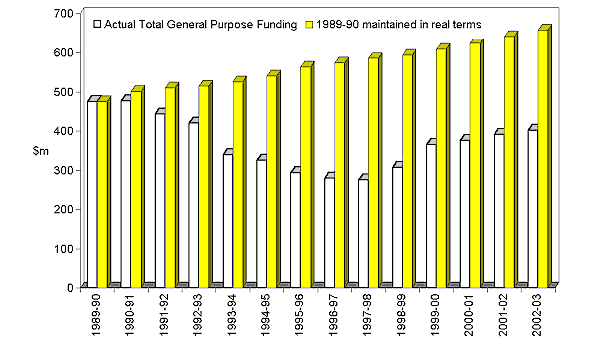
Note: Estimates from 1999-2000 assume no change in the ACT’s relativity factor and maintenance of the states’ pool in real per capita terms.
Total General Purpose Funding includes Financial Assistance Grants (Financial Assistance Guidelines), Transitional Allowances, Special Fiscal Needs, Special Revenue Assistance (funding ceased in 1995-96), Competition Payments and General Purpose Capital funding (ceased in 1993-94).
Over a period of nine years from 1989-90 to 1998-99, general purpose funding to the ACT has been dramatically cut by 49% in real terms. Although this reduction is now beginning to be turned around by Commonwealth Grants Commission recommendations, the ACT in 1999-2000 is still 40% or some $245m worse off in real terms had the 1989-90 funding been maintained. In accumulated terms, this translates into a loss of $1.8b over the nine year period.
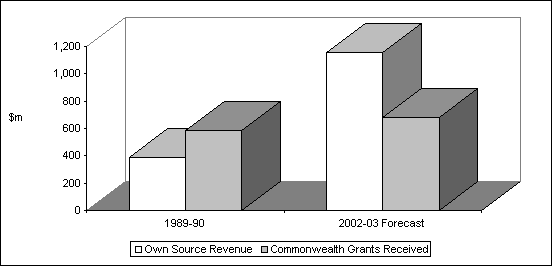
This adjustment is reflected further in Figure 2.2.2 which shows the reversal of ACT own-source revenue and the Commonwealth grants received in the period from the time of
self government to 2002-03.
Figure 2.2.2
Change in trends of ACT Revenue and Commonwealth
Grants received between 1989-90 and 2002-03
Source: Own source revenues - ABS and ACT Budget Papers; Commonwealth Grants are comprised of General Revenue, Specific Purpose Payments (SPPs) and Other Commonwealth Payments - ACT Budget Papers
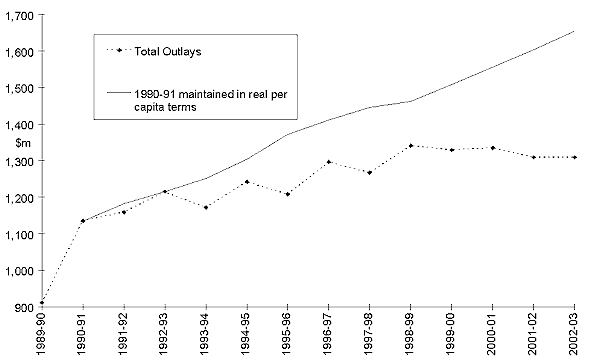
Conversely, Figure 2.2.3 illustrates the fiscal prudence of the ACT regarding expenditure. Outlays have fallen in real per capita terms since 1990-91 when all functions were transferred to the ACT. The ACT’s expenditure in 1997-98, the latest year data available from the Commonwealth Grants Commission, is marginally above the Australian average after adjusting for specific influences on ACT costs.
Figure 2.2.3
ACT Outlays, 1989-90 to 2002-03
During the transition phase, the Territory has made considerable progress in maximising the opportunities to secure additional funding in the context of Commonwealth-State financial relations. This culminated in 1998-99 with the recently completed review of methods by the Commonwealth Grants Commission. The 1999 Review recommended a substantial increase in the Territory’s relativity factor for 1999-2000, used to distribute the level of Financial Assistance Grants to the ACT.
The report’s recommendations more accurately reflect the ACT’s actual circumstances, and represent a correctional outcome for past under-funding by the Commonwealth for direct and indirect costs imposed on the ACT, as well as previous underestimates of the ACT’s funding needs since self government. A more detailed analysis of the Commission’s recommendations is provided later in this chapter.
1999 Premiers’ Conference Outcome
The 1999 Premiers’ Conference and the Australian Loan Council met on 9 April 1999 with the two major topics discussed being the consideration of the ‘offer document’ and the Intergovernmental Agreement on the Reform of Commonwealth-State Financial Relations.
Agreement to the ‘offer document’ was reached amongst all jurisdictions and the Commonwealth, including acceptance of the Commission's recommended five year relativities including depreciation to be used to distribute Financial Assistance Grants in 1999-2000 and the remaining four outyears. The five year averaging of relativities will apply until at least the Commission's next review of methods in 2004.
The states and territories also agreed to the Commonwealth’s Intergovernmental Agreement on tax reform, sending a clear indication of their support to the Federal Senate for major changes to the nation’s tax system and Commonwealth-State financial relations.
A more detailed discussion on each of the outcomes follows.
Commonwealth Grant Funding - 1998-99 to 2002-03
Table 2.2.1 summarises expected Commonwealth grant funding to the ACT in 1998-99, 1999-2000 and the forward years.
Table 2.2.1
Commonwealth Grant Funding to the ACT
| Payment Est.Out. $m | 1998-99 Budget $m | 1999-00 $m | Var % | Var Estimate $m | 2000-01 Estimate $m | 2001-02 Estimate $m | 2002-03 Estimate $m |
|---|---|---|---|---|---|---|---|
| Financial Assistance Grants | 279.1 | 344.7 | 65.6 | 23.5 | 356.1 | 366.9 | 378.2 |
| Transitional Allowances: | |||||||
| - Police | 9.8 | 9.3 | -0.5 | -5.1 | 9.3 | 9.3 | 9.3 |
| - Health and Education | 1.3 | 0.0 | -1.3 | -100.0 | - | - | - |
| Net transitional Allowances | 11.1 | 9.3 | -1.8 | -16.2 | 9.3 | 9.3 | 9.3 |
| Special Fiscal Needs: | |||||||
| - Family law matters | 0.2 | 0.2 | 0.0 | 0.0 | 0.2 | 0.2 | 0.2 |
| - Corporate affairs compensation | 3.6 | 3.7 | 0.1 | 2.8 | 3.7 | 3.7 | 3.7 |
| - Items of a capital nature | 10.1 | 0.0 | -10.1 | -100.0 | - | - | - |
| Net Special Fiscal Needs | 13.9 | 3.9 | -10.0 | -71.9 | 3.9 | 3.9 | 3.9 |
| Competition Payments | 3.5 | 7.2 | 3.7 | 105.7 | 7.4 | 11.1 | 11.3 |
| Total General Revenue Assistance | 307.6 | 365.1 | 57.5 | 18.7 | 376.7 | 391.2 | 402.7 |
| Specific Purpose Payments: | |||||||
| - Health (includes HCGs) | 84.3 | 83.7 | -0.5 | -0.7 | 87.3 | 91.1 | 95.2 |
| - Social Security and Welfare | 14.1 | 14.7 | 0.7 | 4.6 | 15.5 | 16.3 | 16.9 |
| - Education | 81.7 | 86.6 | 4.8 | 5.9 | 89.8 | 93.2 | 96.8 |
| - Public Order and Safety | 3.0 | 3.0 | 0.0 | 0.0 | 3.0 | 3.0 | 3.0 |
| - Housing | 22.1 | 27.7 | 5.6 | 25.2 | 27.9 | 28.0 | 28.0 |
| - Local Govt | 46.3 | 47.5 | 1.2 | 2.6 | 48.8 | 50.1 | 51.3 |
| - Other | 13.4 | 28.2 | 14.8 | 110.2 | 5.1 | 2.5 | 2.5 |
| Total Specific Purpose Payments | 264.9 | 291.4 | 26.5 | 10.0 | 277.3 | 284.2 | 293.6 |
| Other Commonwealth Payments | |||||||
|
- Vocational Education and Training | 14.5 | 14.6 | 0.0 | 0.1 | 14.9 | 15.3 | 15.7 |
| - Other | 6.8 | 8.1 | 1.3 | 19.5 | 6.6 | 6.2 | 6.2 |
| Total Other Commonwealth Payments | 21.3 | 22.6 | 1.3 | 6.2 | 21.6 | 21.4 | 21.9 |
| Total Commonwealth Funding | 593.8 | 679.2 | 85.3 | 14.4 | 675.6 | 696.8 | 718.2 |
Note: Totals may not add due to rounding.
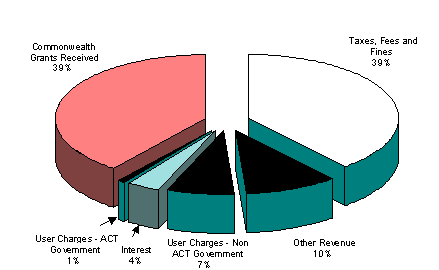
The relative importance of Commonwealth funding as a component of total ACT funding is illustrated in Figure 2.2.4. This shows that Commonwealth grants expected to be received in 1999-2000 total approximately 39% of revenue funding available to the ACT.
Figure 2.2.4
Components of General Government Revenue 1999-2000
To complete the picture, the relative importance of the various types of funding which make up Commonwealth grants received is illustrated in Figure 2.2.5. The two most important components are Specific Purpose Payments and Financial Assistance Grants which represent over 93% of the total.
Figure 2.2.5
Composition of Commonwealth Funding to the ACT 1999-2000
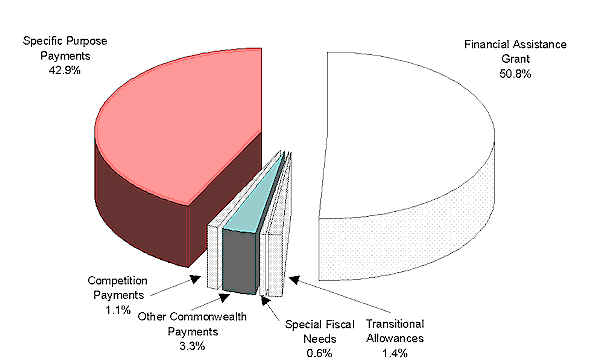
An examination of the changes to each of the components of funding outlined in Table 2.2.1 is discussed in turn.
Total General Revenue Assistance 1998-99 to 1999-2000
Total general revenue assistance to the ACT is estimated to be $365.1m in 1999-2000. This is $57.5m more than in 1998-99, an increase of 18.7%. The reasons for this change are discussed below.
Financial Assistance Grants
The 1999-2000 Financial Assistance Grants (Financial Assistance Guidelines) to the ACT have increased significantly from $279.1m in 1998-99 to $344.7m in 1999-2000, an increase of $65.6m or 23.5%. The increase is mainly due to the application of the ACT’s 1999-2000 per capita relativity recommended by the Commonwealth Grants Commission, which rose from 0.95145 in the 1998 Update to 1.10270 in the 1999 Review and applied to the states’ and territories’ 1999-2000 pool of funding.
Fiscal Equalisation
- Commonwealth Grants Commission updates, and five yearly reviews, are based on the principle of fiscal equalisation. Fiscal equalisation aims to provide each state and territory with the capacity to provide an average level of state-type services. This is assuming each state and territory provides an average level of service at an average level of efficiency, and makes an average effort to raise revenue from its own sources.
- The Commission undertakes this process through a complex methodology that takes account of differences in the per capita capacities of states and territories in providing an average level of state-type services. The capacity to provide an average level of service may differ due to the following reasons:
- there may be influences beyond a state or territory’s control that affect the cost at which it can provide services, or its capacity to raise revenue; and
- state or territory policy, practices and operating efficiency that may differ from those of other jurisdictions.
- Fiscal equalisation requires that only the influences beyond a state or territory’s control be taken into account when determining a state or territory’s relative needs and hence the distribution of Commonwealth financial assistance grants.
The increase in the ACT’s relativity results mainly from a re-assessment of the ACT’s cost drivers of service provision and its lower capacity to raise revenue which are reflected in the new methods put in place by the Commission.
The reasons behind the change in the ACT’s recommended relativity, and a more detailed analysis of the Commission’s methods, are provided in the section titled ‘Detailed Report on the Review of Commonwealth Grants Commission Methodology’.
Commonwealth Grants Commission 1999 Review Outcome - Impact on ACT Financial Assistance Guidelines
- The Financial Assistance Guidelines for 1999-2000 are to be distributed between the states and territories based on the Commonwealth Grants Commission’s 1999 Review Report on General Revenue Grants Relativities.
- The pool of grants distributed by the relativities comprises both Financial Assistance Guidelines and Health Care Grants (HCGs). The ACT’s relativity indicates the per capita level of grants it will receive, compared with the per capita level of grants distributed to other states and territories. HCGs are then deducted from the ACT’s share of the pool to derive the level of Financial Assistance Guidelines. HCGs are separately transferred to the ACT as an SPP.
- The Commission’s recommended relativity for the ACT is above one for the first time since self government and its inclusion in the funding pool. In accordance with this relativity, the distribution of the pool results in the ACT receiving more than its population share of funding. The average per capita amount to be distributed nationally in 1999-2000 is $1,172. The ACT’s per capita amount is nearly $1,293.
- In accordance with the Commission's Terms of Reference, two sets of relativities were produced:
- one based on data averaged over the five year period 1993-94 to 1997-98 (which replaces the corresponding previous set of relativities based on the period 1992-93 to 1996-97); and
- one based on data averaged over the three year period 1995-96 to 1997-98 (which also replaces the relativities based on the period 1992-93 to 1996-97).
- For the first time, the Commission also incorporated a depreciation assessment into the standard budget to assess the recurrent costs of capital faced by jurisdictions. Although its relativities were predicated on the inclusion of depreciation, a separate set of relativities was also calculated which excluded depreciation.
- The 1999 Review resulted in a significant increase in the ACT’s relativity. Between the 1998 Update and the 1999 Review, the five year and three year average relativities increased from 0.95145 to 1.10270 and from 0.95145 to 1.18435 respectively.
- The Commission has couched its analysis of the 1999 Review in terms of the application of the five year relativities (depreciation in) to the pool of grants. A similar approach was followed by the Commonwealth Treasury in respect of its presentation of the 1999-2000 ‘offer document’ to the states and territories. It was subsequently agreed at the 1999 Premiers’ Conference that the five year relativities including depreciation would indeed be used to distribute Financial Assistance Guidelines to the states and territories. The analysis below focuses on this outcome.
- A relativity of 1.10270 implies that the ACT’s share of the Financial Assistance Guidelines pool in 1999-2000 is 110.270% of the share it would receive if the pool was distributed on an equal per capita basis.
- The effect of the five year relativity (depreciation in), based on the figures from the Commonwealth’s 1999 ‘offer document’, is to increase the ACT’s Financial Assistance Guidelines by $65.6m, or 23.5% in 1999-2000, over and above the estimated Financial Assistance Guidelines of $279.1m in 1998-99.
- Further details of the 1999 Review, and their impact on ACT Financial Assistance Guidelines, are illustrated in Tables 2.2.2 to Table 2.2.4.
Table 2.2.2 compares the 1998-99 relativities of all jurisdictions with the five year relativities recommended for 1999-2000. The ACT now joins Queensland, South Australia, Tasmania and the Northern Territory in receiving a per capita share of the grant pool that is above the Australian average (standard).
Table 2.2.2
1998–99 and 1999–2000 Relativities
| State | 1998-99 | 1999-2000 5 year relativities |
|---|---|---|
| NSW | 0.87765 | 0.89948 |
| Victoria | 0.88042 | 0.86184 |
| Queensland | 1.02186 | 1.00687 |
| Western Australia | 0.98252 | 0.94793 |
| South Australia | 1.22194 | 1.20680 |
| Tasmania | 1.55086 | 1.60905 |
| ACT | 0.95145 | 1.10270 |
| Northern Territory | 4.81869 | 4.84429 |
The reconciliation in financial assistance grants between 1998-99 and 1999-2000 of $65.6m is illustrated in Table 2.2.3.
Table 2.2.3
Factors affecting the change in Financial
Assistance Grants to the ACT 1998-99 to 1999-2000
| Use of 1999 Review Five Year Relativity | Change in ACT's Financial Assistance Grant | |
|---|---|---|
| $m | 55.4 | |
| Data | ||
| Changed financial data | -7.8 | |
| Adoption of 1996 Census data | 3.1 | |
| Method | ||
| Inclusion of depreciation | -6.6 | |
| Changed SPP treatment | -15.1 | |
| Changed revenue methods | 18.5 | |
| Changed expenditure methods | 38.9 | |
| Substitution effect | ||
| Substitution of 1997-98 for 1992-93 | 24.4 | |
| New population estimates | -2.1 | |
| Financial Assistance Guidelines indexation | 11.4 | |
| Health Care Grant increase | 0.9 | |
| Total increase of ACT Financial Assistance Guidelines | 65.6 | |
Transitional Allowances
At the time of self government, the Commonwealth Grants Commission recognised that the ACT inherited a high cost structure based on Commonwealth policies and would require a period of transition to fully implement its own policy priorities in a range of service areas.
The Commission considered that the ACT would be able to correct its high cost service structure within an eight year period, and recommended that the ACT receive additional funding commensurate with this period. The level of this ‘transitional funding’ has diminished over the eight years, reflecting the Commission’s judgement that the ACT has been able to increase its policy and cost control in the areas which required transitional funding.
Transitional allowances will be reduced by $1.8m in 1999-2000, or 16.2%, in line with the Commission’s recommendations. Both health and education transitional allowances expired at the end of 1998-99 and the only remaining transitional allowances to be paid to the ACT will be for policing, totalling $9.3m in 1999-2000. This effectively completes the ACT’s transition to state-like funding. Continuation of the transitional allowance for policing reflects the ACT’s ongoing contractual relationship with the Australian Federal Police.
Special Fiscal Needs
The Commission also recommends funding to the ACT for special fiscal needs to take account of differences in financial arrangements between the Commonwealth and the ACT and the Commonwealth and the states for a number of services.
Special fiscal needs will decrease by $10m in 1999-2000, resulting from the cessation of funding for items of a capital nature which the Commission stated could no longer be substantiated.
National Competition Policy Payments
In April 1995, the Commonwealth, state and territory governments signed the National Competition Policy agreements. The policy obliges the ACT to:
- give effect to the reforms in each of the three intergovernmental agreements;
- meet target dates for and regularly report on the review of all anti-competitive legislation and the implementation of competitive neutrality;
- publish a Competitive Neutrality Statement;
- establish effective independent prices oversight;
- provide for independent regulation of access to infrastructure and arbitration of access disputes; and
- effectively implement all COAG agreements on electricity, gas, water and road transport access reforms.
In return for meeting this policy, the distribution of funding from the pool of Financial Assistance Guidelines to the states was to be maintained in real per capita terms. Also payments were to be provided specifically related to competition policy.
Competition payments were to be paid in three tranches, with the first tranche payments commencing in July 1997. The tranche payments to the states and territories are $200m per annum from 1997-98 (first tranche), $400m per annum from 1999-2000 (second tranche) and $600m per annum from 2001-02 to 2005-06 (third tranche). The expected funding is expressed in 1994-95 dollars and is escalated annually to account for inflation and distributed amongst the states and territories on a population share basis.
The overall financial benefit accruing from competition payments to the ACT is estimated to be $243m for the 1997-98 to 2005-06 period. In 1999-2000 the Commonwealth is expected to pay the ACT $7.2m.
Specific Purpose Payments (SPPs) 1998-99 to 1999-2000
SPPs for the ACT are expected to increase by approximately $26.5m or 10% in 1999-2000 when compared to 1998-99.
The major developments in 1998-99 and expected changes in 1999-2000 are outlined in turn.
National Public Health Agreement
The ACT, together with the Commonwealth, signed a bilateral Public Health Outcome Funding Agreement on 3 July 1998.
By signing the agreement, the ACT secured an agreed sum of $6.378m over two years for public health programs, giving the ACT greater flexibility in the allocation of those funds.
This agreement reflects a departure from the past where the Commonwealth distributed these funds as tied SPPs. The new agreement now allows the ACT more flexibility in tailoring spending to meet local needs and priorities to achieve specific goals.
Commonwealth/State Disability Agreement
The ACT, together with the Commonwealth, signed a new Commonwealth State Disability Agreement (CSDA) on 11 June 1998.
The initial CSDA was due to end on 30 June 1997, but was extended on a month by month basis pending this new agreement.
By signing the agreement, the Commonwealth will provide the ACT with total funding of $21.5m over a five year period. This figure is in 1997-98 dollars and excludes the indexation figure which is set in the annual Commonwealth Budget and added to each year’s appropriation.
In addition to the main offer, the ACT has been offered $0.5m by the Commonwealth over the life of the agreement to be used to provide services addressing an identified service gap at the interface between day activity and employment services.
The agreement also offers the ACT the opportunity to negotiate bilateral agreements with the Commonwealth on strategic issues.
In April 1999, a meeting between the Commonwealth, state and territory Ministers was held to discuss the issue of unmet demand. Due to the issue not being resolved, a further meeting has been scheduled before the end of the 1998-99 financial year. At this meeting it is expected that the Commonwealth will make an offer to states and territories reflecting their responsibilities in meeting unmet demand.
Home and Community Care Agreement
On 29 March 1999, the ACT, together with the Commonwealth, signed formal agreements that revise and reform Home and Community Care (HACC) operations. This paves the way for an increase in funding to the ACT, and provides a total of $10.851m in 1998-99 for HACC programs in the Territory. Of this $10.851m in funding, $5.304m is funding provided by the Commonwealth, and $5.547m is funding from the ACT.
For the first time, the new agreement allows private sector organisations to participate in the HACC programs, and will ensure that funding is linked to actual services delivered to patients in need.
The agreement also enhances the capacity of the ACT and Commonwealth governments to pursue reform in the community care sector and reduce duplication in administering the HACC program.
This agreement is ongoing, however, it has been agreed that Ministers can cease the arrangements at any stage. A two year sunset clause applies, that is, the agreement will not expire until two years after a Minister requests the arrangements to cease.
Commonwealth-State Housing Agreement
The Commonwealth-State Housing Agreement (CSHA) was to expire on 30 June 1998. As the deadline for reaching agreement on another CSHA could not be achieved, an interim agreement was negotiated which expires on 30 June 1999.
State Housing Ministers were expecting a new CSHA offer in June 1998, however, progress was stalled by the Federal election in October 1998.
In order to recommence CSHA negotiations with the Commonwealth, state and territory Housing Ministers, as a starting basis, jointly drafted a Multilateral Agreement which recognises the agreed national housing principles proposed by the Commonwealth. Jurisdictions have also individually prepared Bilateral Agreements which support the request for funding under the Multilateral Agreement, and which target housing needs. The Multilateral and Bilateral agreements are still subject to further deliberation between the Commonwealth and states.
The ACT has also been constructively working towards implementing reforms to housing in the areas of pricing, tenure, eligibility and demand management, with the aim of eliminating many of the inefficient features of the old agreement.
As part of the ongoing deliberations, the states and territories expressed strong concerns over the potential for increased costs to public housing programs arising from the introduction of a GST.
This issue was settled at the 1999 Premiers’ Conference with the Commonwealth agreeing to compensate jurisdictions accordingly. A clause was added to the Intergovernmental Agreement on the Reform of Commonwealth-State Financial Relations (IGA) which provides $269m in total to states and territories within the new CSHA to cover these costs. Distribution of the $269m over three years to individual states and territories is still to be agreed by all jurisdictions, and is the major issue yet to be resolved.
Supported Accommodation Assistance Program
The current Supported Accommodation Assistance Program is due to expire in December 1999.
Renegotiation of this agreement has commenced although only at a preliminary level with the vexed question of increased funding for growth yet to be addressed. It is expected, however, that the current agreement will continue for a further five years with no major changes foreshadowed.
A meeting between the Commonwealth and state and territory community services Ministers is scheduled for August 1999.
More details on SPPs are contained in Chapter 5.3 Revenue 1999-2000 and Forward Estimates, Table 5.3.7.
Other Commonwealth Payments
Vocational Education and Training - Australian National Training Authority (ANTA) Agreement
Along with the other states and the Northern Territory, the ACT agreed to the revised Australian National Training Authority (ANTA) Multilateral Agreement in December 1997. The Bilateral Agreement was also signed by the ACT in May 1998.
The ANTA Agreement provides funding for Vocational Education and Training, with the ACT to receive approximately $14.6m in 1999-2000.
This agreement is to be renegotiated in late 2000.
Commonwealth Grant Funding - Forward Estimates 2000-01 to 2002-03
The forward estimates outlined in Table 2.2.1 for Commonwealth funding are discussed below but are generally based on existing policy adjusted for known outcomes. The forward estimates do not presume implementation of national tax reform and the flow on effects of a GST given that the GST legislation has not yet passed the Senate.
Financial Assistance Grants
Estimates for the outyears are based on a number of assumptions including:
- 1999-2000 relativity carried forward pending the outcome of annual updates by the Commonwealth Grants Commission;
- revised CPI and population growth estimates both for the ACT and Australia; and
- an increase in the states’ pool in line with the Commonwealth’s ongoing real per capita guarantee.
Transitional Allowances - Police
Police allowances should continue at the existing level subject to any changes to the current policing contract with the Australian Federal Police which is currently under review.
Special Fiscal Needs
Estimates for special fiscal needs are based at current recommended levels by the Commonwealth Grants Commission.
National Competition Policy Payments
The estimates for the outyears reflect the expected receipts from National Competition Policy payment tranches adjusted for inflation and population growth.
Specific Purpose Payments
The estimates for the outyears reflect the ACT’s best estimate of expected receipts from a range of SPP programs all with different expiry dates. Negotiation and re-negotiation of SPP programs are ongoing, however, the Commonwealth has agreed in the context of the proposed new tax arrangements, to continue to provide SPPs to the states and territories without any intention of cutting the aggregate of all SPPs.
National Tax Reform - Implementation of the GST
Following the October 1998 Federal Election, a Special Premiers’ Conference was convened on 13 November 1998 to reach agreement on the principles underlying a fundamental shift in Commonwealth-State financial relations.
Based on the tax reform agenda outlined in the Commonwealth’s document "A New Tax System" released in August 1998, the states and territories agreed in principle to abolish up to nine of their taxes and give up the present Financial Assistance Grants from the Commonwealth in return for access to all revenues from a Goods and Services Tax (GST). This agreement is underpinned by the Commonwealth’s guarantee that states and territories will be no worse off under the new system than if the current arrangements continued unchanged.
The Commonwealth’s proposal is to levy and collect GST revenue on behalf of the states and territories. GST revenue will be distributed to states and territories based on the principles of fiscal equalisation as presently determined by the Commonwealth Grants Commission.
For the first time, the ACT will be provided with a share of a tax that in real terms is projected to grow at a rate above that of GDP. As such, the Territory can expect to receive a greater level of guaranteed funding which will help to ameliorate the financial burdens it faces in provision of various public services, and its limited revenue sources.
The implementation of a GST will not, however, overcome vertical fiscal imbalance. The Federal Government still funds approximately $16b a year in specific purpose payments which are conditional on the states carrying out agreed programs.
State and Territory Issues
The states and territories will benefit from the introduction of the new tax system by gaining access to a growth tax and will reap further advantages from the expected increase in economic activity resulting from reform of the tax system.
In the transfer to the new system, the 1999 state and territory Leaders’ Forum identified three key issues for states and territories as:
- certainty of the arrangements into the future;
- all GST revenue to be distributed to the states and territories; and
- the Commonwealth guarantee that states and territories will be no worse off financially than if the current system continued to apply. It must also take account of all significant costs to states and territories arising from the proposals.
As part of the implementation, a draft Intergovernmental Agreement (IGA) was developed by senior officials for Heads of Government signature at the 9 April 1999 Premiers’ Conference. This was duly signed, but not without intensive negotiations.
The signed IGA encompasses the proposed reform to Commonwealth-State financial relations that are part of the Commonwealth Government’s wider tax reform agenda.
The first two issues identified by the state and territory leaders are effectively dealt with through legislative provision by the Commonwealth and the IGA. Although the Commonwealth Parliament can not bind future parliaments, some degree of certainty is achieved as future changes to the legislation will need to be agreed by both houses of the Federal Parliament. Under the agreement, the states and territories also need to concur. The third item has been subject to negotiation and is covered under the agreement.
As could be expected, the negotiations were not ‘plain sailing’ and a number of difficult issues required resolution at the 1999 Premiers’ Conference. Importantly, from a state and territory perspective, leaders believed the Commonwealth’s original package fell short of the mark in compensating jurisdictions for the impact of the GST on their operations. Seven outstanding issues were identified at the Leaders’ Forum prior to the Premiers’ Conference.
The states and territories were collectively successful in obtaining the Commonwealth’s agreement to six of the seven items on the day. Of particular importance was the Commonwealth’s agreement to increase compensation to the states and territories by close to $1b, covering:
- loss of Wholesale Sales Tax (WST) equivalent payments from Government Business Enterprises, totaling $338m over three years;
- the exclusion of savings to local government from the removal of embedded WST, equating to an additional $210m over three years to the states and territories;
- the impact of the GST on public housing costs, estimated at $269m over three years; and
- the bringing forward, by one year, of the capacity for states and territories to keep the benefits of increased funding from GST revenues which amounts to an estimated $200m.
The impact for the ACT of these concessions was increased funding of approximately $40m over the first three years of the GST (2000-01 to 2002-03).
The Agreement (IGA)
From a state and territory perspective the IGA sets out the conditions of the financial and administrative arrangements between the Commonwealth and state and territory governments. These govern implementation and administration of the GST, cessation of taxes and grants and payment of GST revenues to the states and territories.
As the Commonwealth legislation is presently before the Federal Senate, its final form is unknown. If it is passed by the Senate in its current form, the Commonwealth, states and territories will have signed an IGA that will be retained in its current form. This will regulate the operation of the GST and its distribution between jurisdictions. The key aspects of the agreement are set out below.
Reforms to present tax structures
From 1 July 2000, the Commonwealth will cease to apply wholesales sales tax and the temporary arrangements for the taxation of petrol, liquor and tobacco under the safety net arrangements announced by the Commonwealth on 6 August 1997. The states and territories will need to pass their own respective legislation in order to cease the following taxes:
- financial institutions duty from 1 January 2001;
- debits tax from 1 January 2001;
- stamp duty on marketable securities 1 July 2001;
- conveyancing duties on business property (non-real) from 1 July 2001 and real property non-residential conveyances from a date yet to be agreed to ensure that no state or territory is worse off financially;
- stamp duties on credit arrangements, instalment purchase arrangements and rental (hiring) agreements from 1 July 2001;
- stamp duty on leases from 1 July 2001;
- stamp duties on mortgages, bonds, debentures and other loan securities from 1 July 2001;
- stamp duties on cheques, bills of exchange an promissory notes from 1 July 2001; and
- bed taxes from 1 July 2000.
Changes to Grants
From 1 July 2000, the Commonwealth will abolish Financial Assistance Grants to the states and territories. The Commonwealth has also undertaken in the agreement to continue providing Specific Purpose Payments to the states and territories and has restated its intention to maintain the aggregate level of SPPs as part of the reform process.
Transitional funding arrangements
The Commonwealth has undertaken to ensure that the states and territories will be no worse off financially under the new arrangements than they would have been if the current arrangements continued over the guarantee period. To meet this undertaking for the transitional years, estimates of the Commonwealth grants and state and territory tax revenues forgone will be compared with the outcome under the new system. The amounts calculated to be payable under the old system are termed minimum payment amounts in the agreement.
Where a state and territory would have been financially worse off than under the current arrangements, funds will be redistributed between the states and territories from the ‘gainers’ to the ‘losers’ for the first two years (2000-01 to 2001-02). The Commonwealth will also provide additional funds to make up any shortfall between the aggregate level of GST revenue and the estimated revenues forgone until all jurisdictions are better off.
It is estimated that the ACT will be marginally better off under the new scheme in the second year. However, any gain made under the new system in the second year will be redistributed to the jurisdictions which are worse off, leaving the ACT in the same position it would have been had the system not changed. It is expected that benefits will begin to accrue in the third year (2002-03) when the redistribution between the states and territories ceases.
Significant gains in total revenue are expected to be forthcoming from the new system in 2002-03 and beyond, as the GST is a growth tax linked directly to consumption.
The impact of national tax reform, however, has not been incorporated into the 1999-2000 ACT Budget forward estimates as the Federal legislation underpinning the reforms to the Commonwealth-State financial relations has not been passed by the Senate.
While Heads of Government signed the IGA, the final shape of the tax reform package is unknown, hence forward estimates have been predicated on the assumption of the status quo in Commonwealth-State financial relations. As a consequence, the forward estimates reflect the continuation of the taxes to be discontinued. Such taxes form part of the guarantee by the Commonwealth, that no state or territory will be worse off under the compensatory package.
The additional funds contributed by the Commonwealth to make up the difference between the revenue forgone by the states and territories and the GST revenue will be in the form of an interest free loan in the first year and grants for the second year. While the loan is to be repaid in the second year, the amount of the loan repayment is added to the calculation of revenue forgone.
Distribution of the GST revenue
GST revenue will be distributed between the states and territories on the basis of fiscal equalisation, currently used by the Commonwealth Grants Commission in determining recommended per capita relativities for the distribution of the Financial Assistance Grants.
First Homeowners Scheme
To soften the impact of GST on the cost of home ownership to new market entrants, each state and territory will provide a $7000 one off payment to all eligible applicants. To qualify for assistance under the scheme, neither the purchaser or their spouse must have previously owned a home, either jointly or separately or with some other person. The dwelling to be purchased must be a principal residence and occupied within a reasonable period.
Government liability for GST
All government operations are subject to GST. However, due to constitutional limitations on taxing powers, each jurisdiction and the Commonwealth will undertake to pay the GST. Taxes and charges of a regulatory nature levied by all levels of government will be exempted from the GST through a Commonwealth Treasurer’s Determination. The Treasurer’s Determination is expected to be finalised in July 1999. Under the legislation the Commonwealth Treasurer can make determinations at any time allowing some flexibility to accommodate any new taxes and charging regimes introduced by governments.
Institutional Arrangements
A Ministerial Council will be established from 1 July 1999 to oversee the operation of the agreement. The Council, to be chaired by the Commonwealth Treasurer, will comprise all state and territory Treasurers and, in effect, will replace the annual Premiers’ Conference.
Administration
The GST will be collected and administered by the Australian Taxation Office (ATO) on behalf of the states and territories. The cost of the administration will be divided between the jurisdictions on a per capita basis. States and territories will enter into a formal contract agreement with the ATO, and in accordance with the guidelines set out in the IGA, this allows for an outcomes based contract and Ministerial Council oversight.
Local Government
The Commonwealth presently distributes Financial Assistance Grants for local government to all states and territories as a Specific Purpose Payment. Although the ACT does not have a local government body as such, it does receive payments analogous to those made by the Commonwealth to the states and the Northern Territory.
Under the agreement, the states and territories will take over these payments, and continue to distribute funding to local government bodies on the basis of fiscal equalisation, as recommended by each jurisdiction’s Local Government Grants Commission.
The present distribution will be retained under the new regime with the ACT receiving a similar grant.
Price Monitoring
The Australian Consumer and Competition Commission will monitor prices to safeguard against profiteering from the introduction of the GST from 1 July 1999 to 30 June 2002.
1999 Australian Loan Council Meeting
The Loan Council has a role in commenting on the appropriateness of each jurisdiction’s Loan Council Allocation (LCA), and its sustainability and consistency with national macroeconomic policy. The LCA sets a constraint on public sector borrowing and other financing, including finance and operating leases.
LCAs are based on each jurisdiction’s general government estimated surplus/deficit on a no policy change basis, public trading enterprise sector net financing requirement, memorandum items, and an addendum relating to universities. These are considered by Loan Council having regard to each jurisdiction’s fiscal position, reasonable infrastructure requirements and the macroeconomic implications of the aggregate of all jurisdictions’ LCAs.
Loan Council met on 9 April 1999. All jurisdictions agreed to the proposed 1999-2000 LCAs nominated by the Commonwealth, states and territories, including the ACT’s at -$61m. This implies, on a Government Finance Statistics basis, that the ACT is a net lender.
Detailed Report on the Review of Commonwealth Grants Commission 1999 Methodology
Background
On 3 March 1999, the Commission released its long awaited relativity recommendations from the 1999 Review Report on General Revenue Grants Relativities which replace the methods decided at the last review of methodology in 1993.
The report completes more than three years of research by the Commission into the methods used to apply equalisation to the distribution of funding to the states and territories. The results recognise the arguments put forward by the ACT through the provision of contributions to the Commission's research program, three comprehensive submissions and a week of Territory inspections.
In essence, the ACT provided three comprehensive submissions to the Commission as part of the review process - Main Submission of March 1997, Supplementary Submission of January 1998 and the Final Submission of September 1998. The case presented to the Commission in the submissions included:
- providing alternatives to the Commission’s methods and the quantification process for general revenue and expenditure measures;
- countering claims made by other jurisdictions;
- defining more accurately the cost drivers of service provision when compared to other jurisdictions, particularly national capital influences and cross border service provision, to ensure that the Commonwealth and NSW jurisdictions pay their way in the ACT; and
- convincing the Commission that the transitional funding regime imposed on the ACT over the past ten years of self government required some correction.
Some of the more specific major themes running through all of the ACT’s submissions included:
- the Commission’s treatment of student enrolments in the non-compulsory years of schooling and the failure of the current assessment to provide the ACT with the capacity to provide a standard level of education to the higher than average numbers of students enrolled in the non-compulsory years;
- an increased claim for significant costs arising from the ACT’s status as the national capital predicated on the provision of substantial evidence to the Commission which demonstrated that the current levels of funding fell well short of the Commonwealth’s obligations and the costs that it imposes on the ACT;
- the need to include government sector salaries and wages in the input costs assessment given that it impacts on the cost of, and provision of, services in the ACT; and
- the failure of the Administrative Scale factor to adequately reflect the disabilities associated with the ACT’s diseconomies of small scale relative to the other states.
Outcome
The 1999 Review outcome resulted in a large increase in the ACT’s relativity which more accurately reflects the ACT’s actual circumstances than ever before. It also reflects the comprehensive case presented to the Commission and the acceptance of many of the ACT’s arguments.
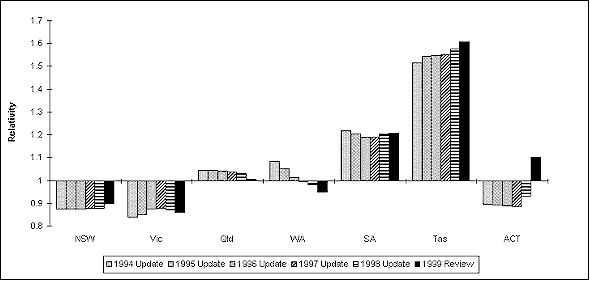
Between the 1998 Update and the 1999 Review, the ACT’s relativity increased from 0.95145 to 1.10270. However, the significance of the increase, and the changes relative to other jurisdictions, can be best viewed by comparing the trend in the relativities between the 1994 Update and the 1999 Review as shown in Figure 2.2.6.
Figure 2.2.6
Trend in the relativities between the 1994 Update to the 1999 Review
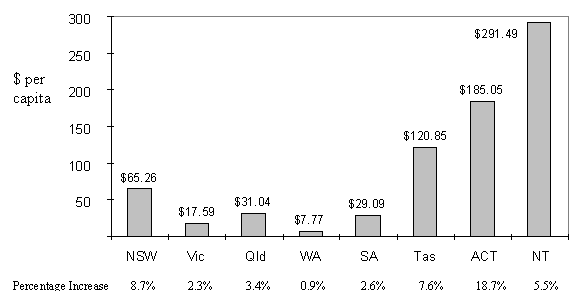
Based on the 1999-2000 estimate in the Commonwealth’s 1999 ‘offer document’, which applied the 1999 Review relativities to the 1999-2000 funding pool, and comparing this to the 1998-99 estimate (1998 Update relativities applied to the 1998-99 funding pool), the ACT stands to procure an additional $57.5m in general revenue assistance. The Territory has successfully gained the largest redistribution of all jurisdictions, an 18.7% increase, or, if measured on a per capita basis, just over $185.00 per person.
The per capita gains for each jurisdiction, and the increase in funding in percentage terms are provided in Figure 2.2.7.
Figure 2.2.7
Gain in General Revenue Assistance (expressed in percentage and per capita terms) in 1999-2000 for each of the states and territories after the 1999 Review relativities are applied to the 1999-2000 funding pool.
To illustrate the extent of the redistribution of funding, Figure 2.2.8 has been provided. This graph shows the gains/losses in general revenue assistance for jurisdictions after comparing 1998 Update relativities applied to the 1998-99 funding pool and the 1999 Review relativities applied to the 1998-99 funding pool.
Figure 2.2.8
Redistribution of funding amongst the states and territories based on applying relativities to the 1998-99 funding pool
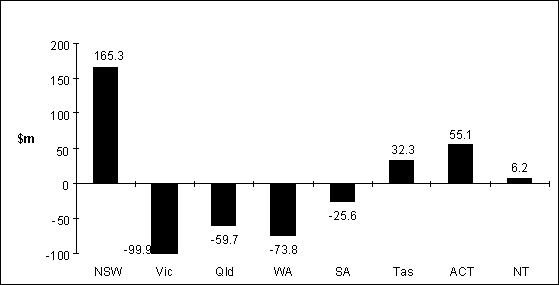
This analysis in Figure 2.2.8 varies from Figure 2.2.7, in that the 1999 Review relativities are applied to the 1998-99 funding pool rather than to the 1999-2000 funding pool. Thus any growth in the Financial Assistance Guidelines pool has not been factored into the equation.
The Commission’s methods are also very useful for determining those services where the ACT overspends (compared with the national average) and where the ACT makes a below national average effort in relation to the collection of state revenues. Such data can be effectively used to assist in the ACT’s budgetary deliberations.
The Commission deems that:
- in the case of expenditure - where a jurisdiction’s actual expenditure is above (below) the standardised expenditure, that jurisdiction is either providing the service inefficiently (efficiently), there is a policy choice to provide an above (below) average level of service, or a combination of the two; and
- in the case of revenue - where a jurisdiction’s actual revenue is above (below) the standardised revenue, that jurisdiction is making an above average revenue raising effort.
The categories in which the ACT still continues to spend above the national average, as calculated by the Commonwealth Grants Commission, in 1997-98 include:
- Pre-school Education + $4.6m;
- Government Education + $65.4m;
- Vocational Education and Training + $19.5m;
- Higher Education + $1.2m;
- Hospitals + $31.6m;
- Community Health + $16.9m;
- Public Health + $1.1m;
- Housing (net) + $5.2m;
- Family and Child Welfare + $8.0m;
- Other Welfare + $8.8m;
- Culture and Recreation + $8.1m; and
- National Parks and Wildlife + $3.2m.
The categories in which the ACT is assessed as making a below average effort in the collection of taxes in 1997-98, include:
- Financial Transaction Taxes - $8.3m;
- Gambling Taxation - $24.3m;
- Stamp Duty on Motor Vehicle Registrations and Transfers - $1.7m;
- Revenue Replacement Payments Tobacco - $3.4m;
- Contributions by Trading Enterprises (including ACTEW) - $51m;
- Hospital Patient Fees - $2.6m;
- Law and Order Fees and Fines - $6.6m; and
- Public Safety and Emergency Service User Charges - $6.4m.
Reasons for Change
The following analysis highlights the reasons for change in the ACT’s relativity, including major changes to the methods. In general, at a highly aggregated level, the increase in the ACT’s relativity has been caused by:
- an increase in the cost of providing the average level of state-type services in the ACT which has jumped upwards by seven percentage points between 1992-93 and 1997-98 (to 2% above the Australian average); and
- a decline in the ACT’s capacity to raise own source revenue which has fallen by almost eight percentage points between 1992-93 and 1997-98 (to 90% of the Australian average).
For both the expenditure and revenue categories, a number of significant method changes and data revision changes have resulted in a significant redistribution of funding to/from the ACT. In net terms, there is increased funding to the ACT. This should be considered as a ‘correctional outcome’, and that changes to the methods have partially helped to address:
- past underfunding resulting from the Commonwealth and NSW not fully compensating for the direct and indirect costs imposed on the ACT; and
- an underestimate of the ACT’s funding needs since self government.
An outline of the major changes are provided below, and illustrate the gains/losses in funding between the 1998-99 Budget distribution and the 1999 Review.
In addition to these changes, there are also substitution effects, which refer to the gains/losses that arise from substituting 1992-93 data with 1997-98 data in the assessment period.
Changes to Expenditure Categories
(i) Method / data revision changes
- Administrative Scale (+ $16.5m) - this factor has been extended to a number of additional categories in the 1999 Review, including: Pre-school; Nursing Home Services; Mental Health Services; Mining, Fuel and Energy; and Manufacturing and Other Industries. Changes to the assessment reflect the adoption of a fixed and variable cost approach, under which expenditure on central office functions and state-wide services is considered in three parts:
- fixed cost expenditure on corporate services, policy advising and planning, and state-wide services;
- expenditure on central office and state-wide services in excess of the fixed costs, but which is still affected by some diseconomies of small scale (scale-affected variable costs); and
- expenditure which varies according to the size and complexity of the service delivery task.
- Urbanisation (Vandalism and Security) (+ $18.8m) - this factor, which accounts for the increased demand for, and cost of service delivery associated with a highly urbanised society, is calculated differently for each of the assessment categories. Some of the urbanisation assessments, such as Police and Vocational Education and Training have now been included in the relevant socio-demographic composition factors for these categories for the 1999 Review. The gains to the ACT mainly emanate from the calculation of an urbanisation factor in the Urban Transit assessment which is based on the proportion of the state population in metropolitan areas and cities of more than 50,000 people. States with a below average proportion of their population in such areas have an advantage. The city-state characteristic of the ACT increases its disability when it is related to the total population.
- Input Costs (+ $11.6m) - changes to reflect the fact that needs arising from the differentials in interstate wages should incorporate not only private sector wages, but also the Commonwealth sector wages which have a large influence on the ACT’s employment costs and the removal of the arbitrary cap on the size of the ACT’s disability.
- Economic Environment (+ $15.2m) - similar to the Urbanisation factor, the Economic Environment factor, which accounts for the disabilities associated with providing certain services arising from the structure and nature of a state’s economy, is very diverse and is calculated differently for each of the assessment categories. The gains to the ACT have emanated from the changes in methods to this factor across a large number of categories. Importantly, the ACT benefited from the unwinding of this factor from the Vocational Education and Training category which occurred as the variations in participation rates between the states could not be attributed to differences in population characteristics. It should be noted that the Economic Environment factor has also been assessed for more categories in the 1999 Review than under the 1998 Update.
- Schools Education (+ $19.4m) - the major gains to the ACT arose from changes to the secondary school assessments (government and non-government) which reflect the Commission’s acceptance of the ACT’s argument that the use of average participation rates to calculate numbers of non-compulsory secondary school students failed to recognise that it was mainly socio economic status rather than ACT policy that drove above average needs. The main change to the socio-demographic composition factor for the secondary education assessments involved calculating standardised participation rates for the non-compulsory years based on the use of the ABS SEIFA indexes of advantage for urban and rural statistical local areas.
- Freight (+ $11.5m) - the argument was accepted that the ACT should be able to legitimately subsidise interstate freight if it wanted to, even though it had no internal freighting requirements of its own.
- Aged and Disabled Welfare (+ $7.4m) - increase in funding to the ACT arising from a new method based on separate assessments for the aged and disability services components which increased the emphasis on the population aged below 60 years (after the Northern Territory, the ACT has the lowest proportion of its population aged above 60 years).
- Hospitals (- $17.4m) - a more rigorous socio-demographic composition factor based on age/sex, aboriginality, region of residence, income and English fluency (for which the ACT has relatively low proportions compared to other states) and the introduction of casemix data and Diagnostic Related Groups cost weights to determine the level of use of hospital services and the costs of providing those services reduced the ACT’s needs.
Depreciation/Debt Charges (- $25.6m) - the introduction of the depreciation assessment which reflects the recurrent costs of capital, and its effect on debt charges, resulted in lower needs as the Territory is assessed as having relatively low borrowing needs and demands for capital stock.
(ii) Substitution effects
- Debt Charges (+ $10.1m) - reflects the ACT’s higher cost of servicing debt and employer superannuation as the period since self government increases and the ACT moves closer to the national average debt level.
Changes to Revenue Categories
(i) Method / data revision changes
- Payroll Tax (+ $9.9m) - tightening of the revenue base to exclude the estimated wages and salaries of members of the defence forces and employees of embassies and consulates.
- Contributions by Trading Enterprises (+ $9.8m) - assessment of needs replaced by an equal per capita assessment given that national competition policy considerably reduced the scope for raising revenue from PTE’s.
(ii) Substitution effects
- Stamp Duty on Conveyances (+ $7m) - reflects a decrease in the ACT’s capacity to raise stamp duty on conveyances because of a decline in ACT property values and a reduction in property sales.
The Way Forward
Future Research
A thorough examination of the Commission’s methods will be undertaken in the future by analysing the Working Papers with a view to:
- finding any data or methodological errors, and having them corrected by the Commission;
- examining whether the ACT’s arguments have been accepted or rejected and determining how similar arguments could be enhanced for the next Review;
- determining what data agencies could start collecting in order to support future arguments, for example, better collection of cross-border data; and
- developing strategies to ensure that the ACT is fully compensated for any shortfall in Commonwealth funding provided to the ACT in respect of national capital factors, including developing national capital claims on a fee for service basis or block grant for particular services.
Future Prospects for ACT Relativities
The 1999 Premiers’ Conference agreed that the next major methodological review will be prepared by the Commission in 2004. This means that, with the exception of minor corrections and any changes necessary to implement National Tax Reform, the methods used to derive the annual relativities will remain unchanged for the next five years. As a consequence, the major influence on changes in relativities will be the relative economic circumstances of the ACT compared with the rest of Australia.
The ACT is confident that its future relativities, to be recommended by the Commission in prospective updates, will continue to be favourable. In general, the ACT considers that the Commission’s latest review more accurately reflects the Territory’s actual circumstances than ever before given the comprehensive case presented to the Commission.
In order to analyse what relativities the ACT might receive over the next five years, before the next major review takes place, a number of graphs are provided which assess the trends in the ACT’s relativities between 1993-94 and 1997-98. Figure 2.2.9 highlights the ACT’s overall relativities for the 1998 Update compared with those in the 1999 Review, while Figures 2.2.10 and 2.2.11 illustrate the disaggregation of these relativities on an expenditure and own source revenue basis.
In terms of the ‘overall’ relativities (Figure 2.2.9), the gap between the 1998 Update line and the 1999 Review line indicates the extent of the change in the ACT’s favour, predominantly as a result of the latest methods adopted by the Commission.
Although the 1997-98 relativity did not form part of the 1998 Update, it has been estimated for comparative purposes only.
The ACT’s forecast is for continued increased relativities for the Territory (above one, or above an equal per capita share) in each of the years before the next major review. This is predicated on the fact that:
- the methods adopted by the Commission in the 1999 Review, which is likely to increase the ACT’s funding, are effectively ‘locked in’ for five years;
- the current methods provide for an increase in the ‘expenditure’ relativity over the next five years;
- the ACT economy is forecast to grow broadly in line with overall national economic growth, suggesting that, subject to unexpected large one-off revenues (such as occurred in 1997-98), ‘revenue’ relativities will remain relatively unchanged over the next five years; and
- the effect of the rolling five year averaging process used by the Commission will be to replace the earlier years of the review period, and their lower relativities, with the later year’s higher relativities.
Although future ACT relativities are likely to be above one, and thus result in increased Financial Assistance Grants (Financial Assistance Guidelines), or a greater share of the GST pool for the Territory, the gains in untied assistance are likely to be partially offset by a reduction to the ACT’s population growth which is forecast to be less than half of the Australian average (0.5% and 1.2% for 1999-00 respectively).
Figure 2.2.9
1999 Review relativities compared with the 1998 Update relativities
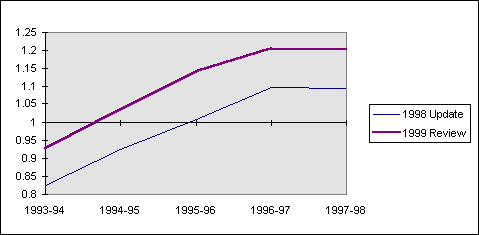
Figure 2.2.10 highlights the increase in the ACT’s 1999 Review ‘expenditure’ relativities over and above those in the 1998 Update, predominantly a result of changes to the methods used by the Commission. Although the 1997-98 relativity did not form part of the 1998 Update, it has been provided for comparative purposes only.
Figure 2.2.10
1999 Expenditure relativities (five year average with depreciation in) compared with the 1998 Update relativities
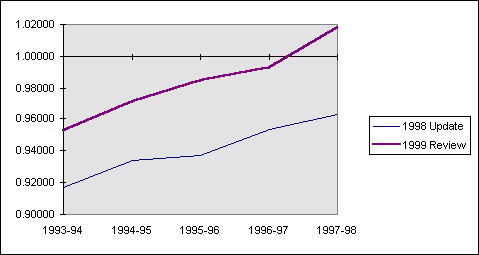
Based on the 1999 Review, the graph shows for the first time, the ACT’s ‘expenditure’ relativity rising above one in 1997-98, reflecting the fact that its cost of service provision increased above the Australian average. The categories in which the major increases to the cost of service provision occurred, and thus resulted in increased funding to the ACT between 1996-97 and 1997-98 include: Debt charges (+ $9.7m); Superannuation (+ $4.9m); Other General Public Services (+ $4.5m); Urban Transit Net (+ $1.8m) and Culture and Recreation (+ $1.2m).
The ACT’s ‘expenditure’ relativity will contribute positively to the overall relativity for the next update as the unfavourable 1993-94 relativity will be replaced by a more favourable 1998-99 relativity.
Future ‘expenditure’ relativities will depend upon the demographic characteristics of the ACT population compared with the other jurisdictions. The changing demographics are in turn partially dependant upon the performance of the ACT economy relative to the other jurisdictions, which influences, for example, the number of welfare recipients. A weaker economy, relative to other states, is likely to increase the relativity as the ACT’s cost of service provision increases. However, such a relationship is tenuous given that the Commission uses demographic data which tend to lag behind economic performance.
However, there are two categories that will have a major impact on the ACT’s future relativities and push the ACT’s relativity higher, those being:
- the debt charges assessment which will continue to increase the ACT’s ‘expenditure’ relativity as a yearly special adjustment over fifteen years is made to allow the ACT to reach a comparable debt position to other states (the ACT is considered to start from a zero net debt position at self government in 1989-90); and
- the superannuation category will also increase the ‘expenditure’ relativity as it is phased in, similar to the debt charges assessment, over a fifteen year period.
Notwithstanding the difficulties in forecasting the ‘expenditure’ relativities over the next five years, given the circumstances outlined above, the outlook is positive.
Figure 2.2.11 highlights the variation in the ‘revenue’ relativities between the 1999 Review and the 1998 Update. A fall in the relativity for revenue items indicates that the ACT’s revenue raising capacity has decreased, and thus its requirement for Financial Assistance Guidelines has increased.
Although the 1997-98 revenue relativity did not form part of the 1998 Update, it has been estimated for comparative purposes.
Figure 2.2.11
1999 Revenue relativities compared with the 1998 Update relativities
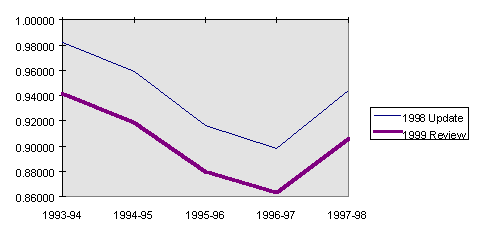
In all years, except 1997-98, there has been a similar downwards trend in the ACT’s 1999 Review ‘revenue’ relativities and the 1998 Update ‘revenue’ relativities reflecting a slowdown in economic growth in the ACT over this period. Between 1996-97, the ACT’s 1999 Review ‘revenue’ relativities have increased as a result of the ACT’s improved revenue raising capacity, mainly as a result of assessed lower needs in the following categories: Stamp Duty on Shares and Marketable Securities (-$11.7m); Payroll Tax (-$4.8m); Stamp Duty on Motor Vehicle Registrations and Transfers (-$3.5m); Stamp Duty on Conveyances (-$2.4m) and Financial Transaction Taxes (-$2.3m). The change in assessment for Stamp Duty on Shares and Marketable Securities reflects some large unexpected revenues received in 1997-98 and therefore is not considered to reflect a trend.
The extent of the change of the relativity in the future will be dependent upon growth in the ACT economy and its effect on actual revenue collections relative to the performance of other jurisdictions. These revenue bases are very diverse, and it is difficult to predict the likely changes to these.
While the ACT economy is expected to improve over the forecast period, this growth is expected to be steady and generally in line with the national rate. This being the case, ‘revenue’ relativities are expected to stabilise for the forward years.